
Politics
WATCH: CNN Host Forced To Admit Trump’s Economy Is Soaring Through Gritted Teeth
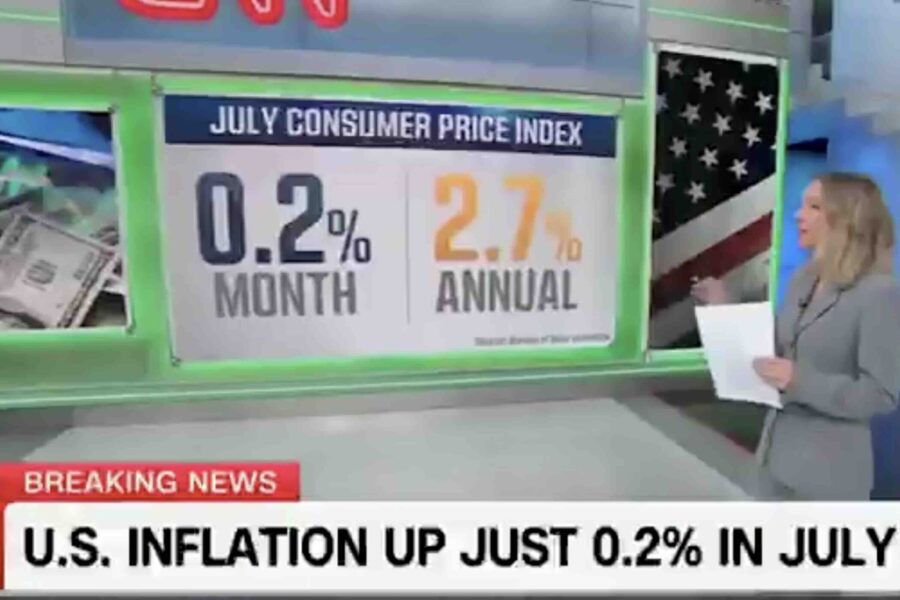
Inflation numbers released Tuesday beat economists’ expectations, sending one CNN anchor into an emotional tailspin as she attempted to explain away why President Donald Trump keeps winning each news cycle.
The July consumer price index (CPI) report showed that total energy prices fell 1.1% while food prices held steady and shelter ticked up 0.2%. Gas prices dropped 2.2%, an anomaly for a summer month where a record number of Americans travel during the summer holiday season, but also a reflection of a global economic slowdown.
On CNN, a morning anchor could barely stifle her surprise that Americans aren’t feeling a greater pinch at the grocery store after countless economic experts warned about the shock that President Trump’s tariffs would have on food prices.
“Look at the food!” she exclaimed. “I mean, this is where people spend their money, right? Food, every single day. Food, flat, 0 percent, and actually down at the grocery store by 0.1 percent.”
Overall inflation held steady at 2.7%, unchanged from June and below the 2.8% estimated by economists polled by the WSJ.
Core inflation remains a thornier subject. Excluding food and energy prices, inflation rose 3.1%, just above the 3% expected.
U.S. stocks shrugged off the difference and opened higher on Tuesday morning.
The CPI report keeps the possibility of a rate cut by the Federal Reserve firmly on the table at its next meeting in September. Fed Chair Jerome Powell has indicated he would be encouraged by economic data showing that no abrupt rise in prices is occurring as a result of President Trump’s tariffs.
WATCH:
Overall, say economists, the picture is looking rosy for consumers who might otherwise have feared the worst.
“Consumers might be taking some relief in the fact that some of their most common and most necessary purchases are seeing easing price pressures,” said Bank of America senior U.S. economist Stephen Juneau.
Several consumer categories affected by tariffs, including furniture, tires, and pet products, all experienced slight increases of 0.9%, 1%, and 0.5%, respectively.
“Companies are trying to be mindful of how much they push pricing after coming off of pandemic price shocks,” said Michelle Meyer, chief economist at Mastercard.
The data may show that “businesses are eating some of the costs,” she added.
With tariffs introduced six months ago, experts say the passage of higher prices onto consumers is likely to occur. At the same time, immigration crackdowns in key sectors like agriculture have raised concerns that a higher cost of doing business would be reflected in each month’s grocery prices. So far, however, that appears not to be the case.
“We really are just now on the doorstep of seeing the pass-through effects,” Michael Gapen, Morgan Stanley’s chief U.S. economist, told the WSJ. “And we expect to see more of it.”
