
Politics
Beloved Pastor Blocked From Prayer Service By Muslim Imam In Texas
Pastor Tom Ascol says his recent experience at Dallas-Fort Worth Airport highlights what many Christians see as a troubling shift in how faith is treated in public spaces.
Ascol, a well-known Baptist pastor, had been curious when he saw signs for a “prayer service” at the airport chapel. But what he walked into was not what he expected.
“I had very low expectations,” Ascol admitted in a social media post. Even so, he hoped there might be at least some Scripture reading or Christian worship. Instead, through the door he saw “several men kneeling on mats” as an Imam led Muslim prayers from the corner of the room.
When he attempted to enter, Ascol said the Imam physically shifted to block him. “When I made a move to step further toward the door, [the Imam] shifted his position to stand directly in front of me, making it clear that this prayer service was only for certain kinds of people, namely Muslims.”
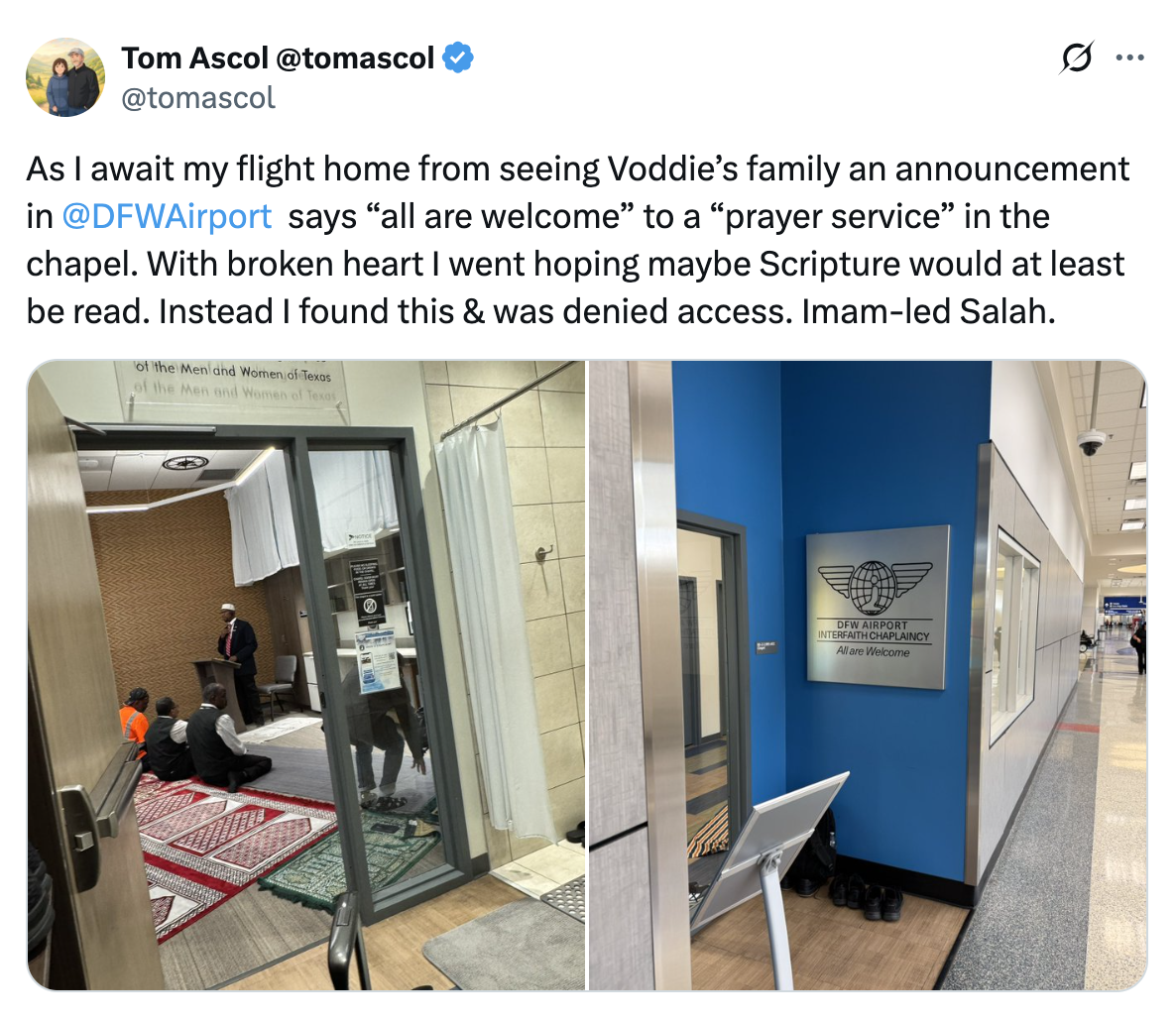
The pastor walked away disturbed but also determined. “It has provoked me to pray more diligently that the Lord would revive His people,” he wrote. He added that the exclusion cut deeply: “It grieves me as a native Texan. It grieves me as an American. It grieves me most as a Christian who is jealous for the glory and honor of the crucified and risen Lord Jesus Christ.”
For Ascol, the moment was not only about personal frustration but about what he sees as a broader cultural trend. Public spaces like airports often advertise themselves as “open to all,” he noted, but his experience left him feeling that the opposite was true.
The story has resonated with many Christians who believe traditional values are being sidelined in favor of a one-way definition of inclusivity. Some argue that public chapels should be shared spaces for all faiths, rather than being controlled by one group to the exclusion of others.
“This sort of status quo is obviously not acceptable,” Ascol’s post implied, sparking new conversations online about religious liberty and fairness in public institutions.
For Ascol, the jarring incident ultimately reinforced his call to prayer. And for many others who have read his account, it has raised a pressing question: what does “inclusion” really mean when believers are left standing outside the door?
