
Politics
High-Level ‘Gang Of Eight’ Meeting Hints At Potential Iran Strikes
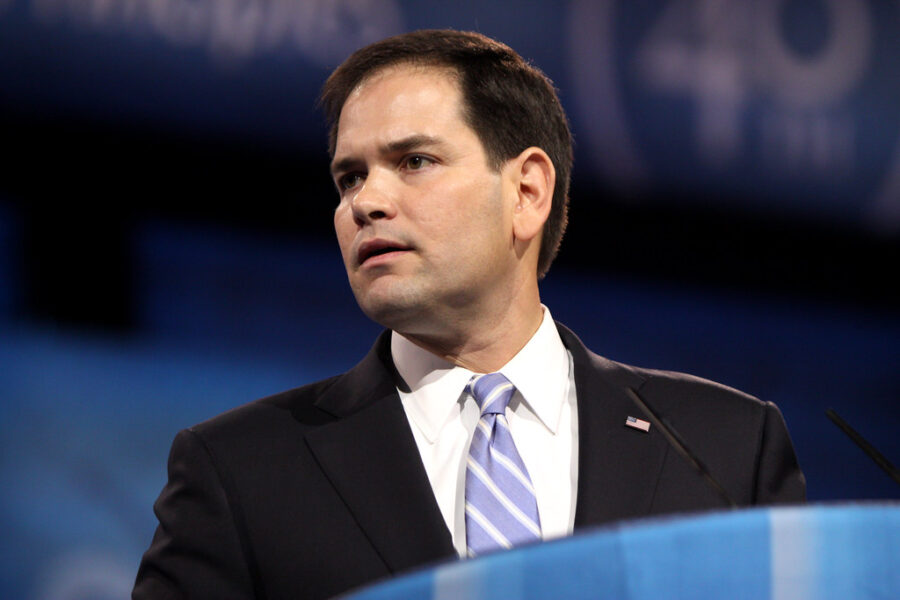
Secretary of State Marco Rubio conducted a classified briefing for the Gang of Eight at the White House amid heightened tensions with Iran.
The group consists of the Speaker of the House, House majority and minority leaders, Senate majority and minority leaders, and the chairs and ranking members of the House and Senate intelligence committees. The briefing addressed the current situation with Iran, occurring hours before President Donald Trump’s State of the Union address that evening.
Such briefings to the Gang of Eight are reserved for senior congressional leaders on sensitive intelligence and national security matters, including situations that may involve significant military contingencies.
The session takes place against the backdrop of an extensive U.S. military presence in the Middle East, described by the White House as the largest deployment of American aircraft and warships to the region since the 2003 lead-up to the Iraq war.
Since late January, the United States has positioned two aircraft carrier strike groups near Iranian waters: the USS Abraham Lincoln carrier strike group, which arrived in the Arabian Sea after redirection from the South China Sea, accompanied by guided-missile destroyers; and the USS Gerald R. Ford, the world’s largest aircraft carrier, with its associated strike group, which deployed in mid-February. Overall naval assets include at least 16 U.S. Navy ships.
Air assets moved into the region and supporting European bases number more than 150 aircraft, including over 100 fighter jets (such as F-35s, F-22s, F-15s, and F-16s), more than 100 aerial refueling tankers, over 200 cargo planes, and additional early-warning aircraft. Ground-based assets, such as F-15E Strike Eagles at bases in Jordan and Saudi Arabia, have also been augmented.
U.S. Central Command has described these movements as enhancing regional security and combat readiness.
President Trump set a public timeline for progress in negotiations on February 19, 2026, stating that Iran had approximately 10 to 15 days to reach a deal or face consequences. “You’ll be finding out over the next probably 10 days,” he said, further describing that “10, 15 days, pretty much maximum” would be sufficient.
The president added that failure to secure an agreement would result in “really bad things” for Iran. The administration’s stated demands include Iran’s complete abandonment of its nuclear program (with zero uranium enrichment), cessation of ballistic missile production, and an end to support for regional proxy groups such as Hezbollah and the Houthis.
Direct talks between U.S. and Iranian representatives are scheduled for Thursday, in Geneva, which will be mediated by Oman. The U.S. side will be represented by special envoy Steve Witkoff and Jared Kushner, with involvement from senior officials including Vice President JD Vance, Secretary Rubio, and others. Iranian Deputy Foreign Minister Majid Takht-Ravanchi stated in a recent NPR interview that Iran is “ready to reach an agreement as soon as possible” and is prepared to discuss its nuclear program.
White House spokeswoman Karoline Leavitt reiterated on February 24 that “President Trump’s first option is always diplomacy. But as he has shown … he is willing to use the lethal force of the United States military if necessary.”
The briefing to the Gang of Eight provides congressional leadership with current intelligence assessments and contingency information at a time when military forces are positioned for potential operations if diplomatic outcomes do not align with U.S. requirements by the indicated timeframe.
RELATED: U.S. Forces Thwart Massive ISIS Prison Break In Covert Operation
