
Politics
Iran Strikes 3 Ships Near Strait Of Hormuz
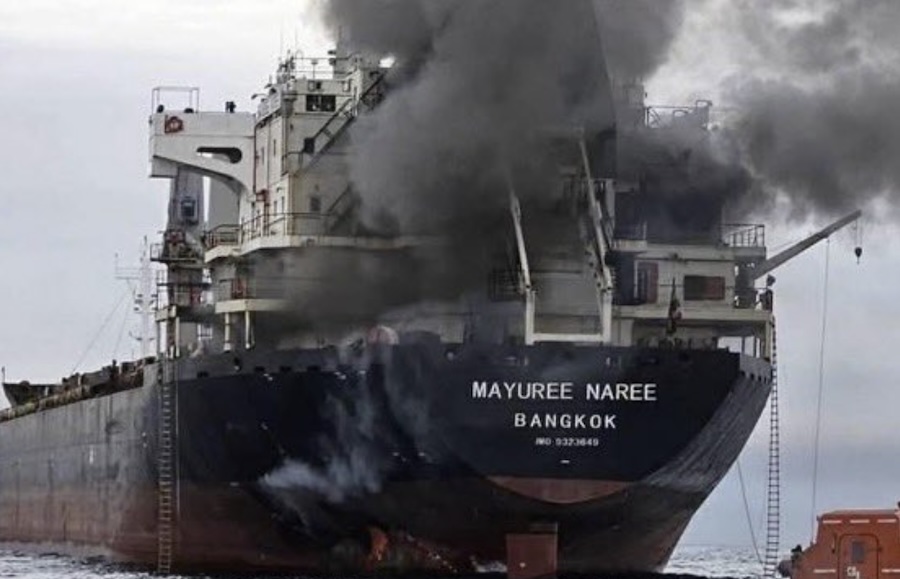
Iran intensified pressure on global shipping on Wednesday after three commercial vessels were struck near the Strait of Hormuz, the vital passage for global energy supplies and one of the world’s most sensitive maritime corridors.
The incidents brought the number of ships hit in the region since the current conflict began on Feb. 28 to at least 14, as fighting between Iran and the United States and Israel continues to ripple across the Gulf.
The most serious strike involved the Thai-flagged bulk carrier Mayuree Naree, which was hit by two projectiles while transiting the strait roughly 11 nautical miles north of Oman. The attack ignited a fire and damaged the ship’s engine room, Reuters reported.
The vessel’s operator, Precious Shipping, said three crew members were missing and believed trapped inside the engine compartment after the strike. The remaining 20 crew members were evacuated and taken ashore in Oman.

Images released by the Thai navy showed smoke billowing from the vessel, an indication of how hazardous commercial transit through the narrow waterway has become.
Iran’s Revolutionary Guards later said the ship had been “fired upon by Iranian fighters.” The statement is the first public claim by the Guards of a direct engagement with a commercial vessel during this phase of the conflict.
Two other ships were also struck on Wednesday, though both appeared to sustain less severe damage. The Japan-flagged container ship ONE Majesty was hit by an unidentified projectile about 25 nautical miles northwest of Ras Al Khaimah in the United Arab Emirates.

The ship’s owner and charterer said the vessel suffered minor damage above the waterline but remained fully operational and seaworthy. All crew members were reported safe.
A third vessel, the Marshall Islands-flagged Star Gwyneth, was damaged while anchored roughly 50 miles northwest of Dubai. Maritime security sources said the projectile strike damaged the ship’s hull in the hold area, though there were no injuries and the vessel was not reported to be listing.
The attacks are the latest sign that the Strait of Hormuz, a narrow waterway linking the Persian Gulf with the Gulf of Oman, is becoming increasingly perilous for merchant shipping.

Maritime traffic through the corridor has slowed sharply since the United States and Israel began military strikes on Iran on Feb. 28. The disruption carries global implications. Roughly one-fifth of the world’s oil supply normally passes through the strait.
Iran’s Revolutionary Guards have warned that ships moving through the waterway could be targeted as long as the conflict continues. Iranian officials have also threatened to halt oil shipments from the region entirely if U.S. and Israeli attacks persist.

Oil prices have already swung sharply in response to the escalating tensions. Energy companies have begun adjusting their shipping routes. Saudi Aramco has started redirecting some tankers away from the strait, relying instead on the kingdom’s east-west pipeline to move crude to the Red Sea.
The U.S. Navy has so far declined frequent industry requests for escorts through the strait, citing the dangers of operating in such a volatile environment. President Donald Trump has said the United States stands ready to provide naval escorts if necessary.
