
Polling
JUST IN: New Poll Shows Tight Races For Governor, Senate In ‘Trump Country’
Ohio may not be the swing-state bellwether it once was, but the Buckeye State is still giving an early look at the political battlefield heading into 2026.
A new Quantus Insights survey conducted March 13–14 shows Ohio voters divided, uneasy about the economy, and not lining up neatly behind either party.
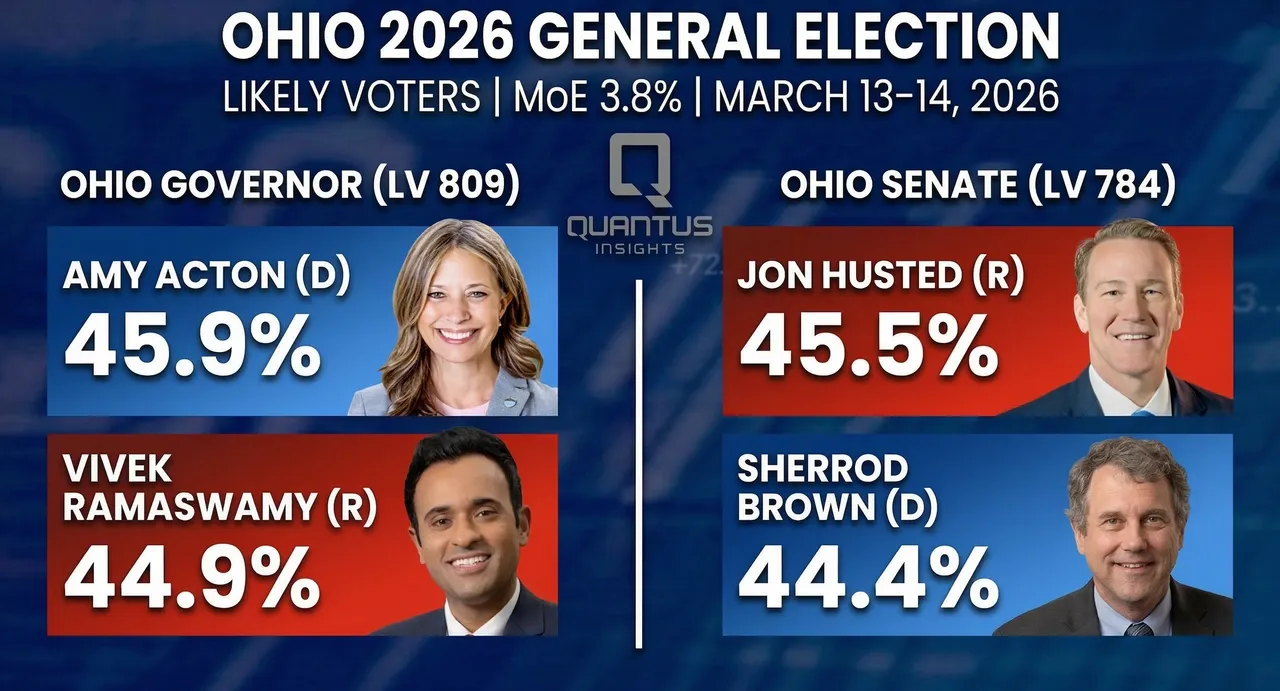
The early governor’s race looks like a photo finish.
Democrat Amy Acton pulls 45.9% in the ballot test, while Republican Vivek Ramaswamy sits just behind at 44.9%. Another 5.9% say they’re undecided, and 3.3% back another candidate.
The tight margin comes after earlier polling this month showed Acton with a much larger lead, suggesting the race may already be tightening as the campaign begins to take shape.
Neither candidate is close to clearing 50%, a sign that voters are still making up their minds months before the election.
The Senate race looks just as tight.
Republican incumbent Jon Husted holds 45.5%, compared to 44.4% for Democrat Sherrod Brown. Another 6.5% remain undecided, while 3.6% say they support someone else.
Brown has spent years branding himself as a champion of working-class Ohioans, especially in the state’s old industrial regions. But the close numbers suggest that the message is facing a tougher environment in a state that has drifted to the right in recent years.
Husted, meanwhile, is still settling into the role after being appointed to the seat in January 2025 when JD Vance stepped down to serve as vice president under President Donald Trump.
Trump’s standing in Ohio reflects a country where most voters have already picked a side.
About 47% approve of the job he’s doing, while roughly 50% disapprove. The rest say they’re unsure.
Asked whether their view of Trump has changed recently, about 44% say it hasn’t. Another 28% say their view has improved, while 27% say it has worsened.
In other words, most Ohio voters aren’t budging.
What they are focused on is the economy.
Roughly 25% of voters say the most important issue facing the state is the economy, inflation, and the cost of living. Threats to democracy and border security follow behind, with healthcare, taxes and spending, crime, foreign policy, and election integrity rounding out the list.
Pocketbook issues still dominate in Ohio.
Even on social questions, voters remain split.
About 43% support recognition of same-sex marriage, while 40% oppose it and 17% say they’re unsure.
When voters are asked who they trust more to handle the economy as governor, Ramaswamy holds an advantage.
About 42.9% pick the Republican, compared to 36.2% for Acton. Another 13.6% remain undecided, while 7.3% say someone else.
That edge could matter in a state where economic frustration still drives much of the political conversation.
The Senate race shows the opposite dynamic.
Asked who they trust more to handle economic issues in Washington, voters give Brown a lead with 44.2%, compared to 39.6% for Husted. Roughly 12% remain undecided.
Brown’s long-running focus on manufacturing jobs, trade, and labor issues still appears to resonate with part of the electorate.
Immigration also registers as a major political issue.
About 44% of voters say deportation policies are good for Ohio, while 39% say they are bad. Another 17% say they’re unsure.
Asked who would better handle immigration policy in Ohio, Ramaswamy leads Acton 41% to 37%, with the rest undecided or choosing neither.
Healthcare moves the numbers in the other direction.
Acton leads Ramaswamy 42.6% to 39.0% on who voters trust more to handle healthcare costs and policy. Roughly 18% remain undecided or say neither.
That remains one of the few issues where Democrats still hold a measurable advantage with voters.
Brown also keeps a small edge when voters are asked which Senate candidate would better represent working families.
About 44% pick Brown, compared to 40% for Husted.
Taken together, the survey shows a state that remains politically competitive even as it trends Republican at the federal level.
Republicans hold advantages on immigration and the economy in the governor’s race. Democrats maintain pockets of strength on healthcare and working-class messaging.
With voters focused on inflation, wages, and the cost of everyday life, the side that convinces Ohioans it has a plan for their wallets will likely have the upper hand in 2026.
Download the FREE Trending Politics App to get the latest news FIRST >>
