
Politics
BREAKING: Pentagon Weighs Sending Elite Airborne Troops To Middle East

The Pentagon is preparing to deploy roughly 3,000 soldiers from the Army’s elite 82nd Airborne Division to the Middle East, according to multiple U.S. officials, as tensions with Iran continue to escalate across the region.
A formal order could be issued within hours, officials told The Wall Street Journal, though they stressed that no final decision has been made to send American ground troops into Iran itself.
The potential deployment would give President Donald Trump a wider range of military options at a moment when the conflict is rapidly expanding. Iran has launched a new wave of attacks targeting Israel as well as U.S.-aligned countries including Kuwait, Bahrain, and Saudi Arabia, raising concerns about a regional war.
At the same time, diplomatic efforts appear uncertain. Trump said earlier this week that the U.S. would delay planned strikes on Iranian energy infrastructure for five days following what he described as “productive” talks. Iran’s Foreign Ministry, however, denied that any negotiations with Washington are taking place, fueling doubts about whether a cease-fire is even on the table.
Behind the scenes, senior military officials are actively weighing how best to position U.S. forces if the situation deteriorates further. According to The New York Times, planners are considering deploying a brigade from the 82nd Airborne Division’s Immediate Response Force, a unit specifically designed to move anywhere in the world within hours.
That force could be used in several scenarios, including the possible seizure of Kharg Island, Iran’s primary oil export hub. Such a move would strike directly at Tehran’s economic lifeline while potentially limiting its ability to fund ongoing military operations.
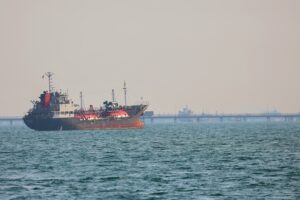
Iran, February 27, 2026: Iran said it would set fire to any ship attempting to pass through the Strait of Hormuz, one of the world’s busiest oil straits.
Another option under discussion involves U.S. Marines already moving toward the region. Roughly 2,500 troops from the 31st Marine Expeditionary Unit could be used in an initial assault, particularly because Marine combat engineers are equipped to rapidly repair damaged airfields. Once infrastructure is restored, additional forces — including paratroopers from the 82nd — could flow in to reinforce and expand operations.
Military officials noted that each force brings different advantages. Marines are well-suited for initial amphibious assaults and engineering tasks, while the 82nd Airborne provides greater staying power once boots are on the ground. However, paratroopers deploy light and do not carry heavy armored equipment, which could leave them more exposed if Iranian forces mount a counterattack.
The Pentagon has been quietly preparing for this possibility for weeks. Earlier this month, the Army canceled a major training exercise for elements of the 82nd Airborne’s headquarters, keeping them stateside to ensure they would be ready to deploy on short notice if needed.
The division has a long track record of rapid deployments in high-stakes situations, including the Middle East following the 2020 attack on the U.S. Embassy in Baghdad, Afghanistan during the 2021 evacuation, and Eastern Europe in 2022 amid rising tensions with Russia.
Officials described the current planning as precautionary, emphasizing that no final decisions have been made. U.S. Central Command has declined to comment publicly on the discussions.
Still, the movement of one of the military’s premier rapid-response units signals how seriously Washington is taking the threat of further escalation. With Iran expanding its attacks and diplomacy offering little clarity, the window for major U.S. action appears to be narrowing.
