
Politics
WATCH: Trump Makes History With Visit To Supreme Court For Birthright Citizenship Case
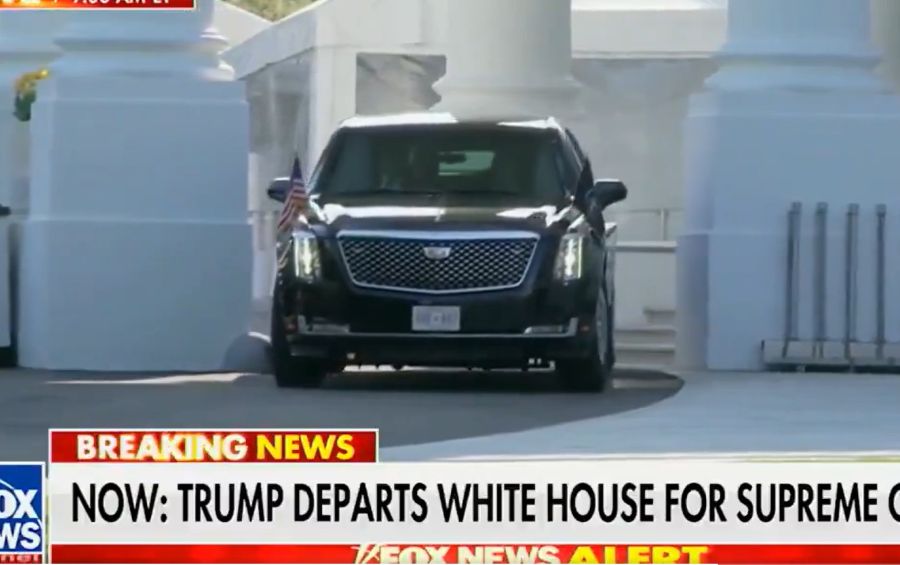
President Donald Trump is heading to the Supreme Court for arguments in his administration’s birthright citizenship showdown, a rare move that underscores how central the case has become to his second-term immigration push.
The high court is set to hear oral arguments Wednesday on the legality of Trump’s executive order seeking to end automatic citizenship for most children born in the United States to parents who are in the country illegally or who are here on temporary non-immigrant visas.
Trump’s appearance in the courtroom is being billed as historic. His attendance marks the first time in U.S. history that a sitting president has attended oral arguments. Attorney General Pam Bondi is also expected to attend.
At the center of the dispute is Trump’s executive order 14160, titled “Protecting the Meaning and Value of American Citizenship.” The order directs federal agencies to refuse to issue citizenship documents to children born in the U.S. to illegal immigrants and to children born to parents who are legally present on temporary visas.
The order would apply to newborns born in the U.S. after Feb. 19, 2025.
The case, Trump v. Barbara, tees up a high-stakes fight over the Citizenship Clause of the 14th Amendment, which says citizenship is granted to “all persons born … in the United States, and subject to the jurisdiction thereof, are citizens of the United States.”
Trump’s team argues the key phrase is “subject to the jurisdiction thereof,” saying it has been misunderstood for decades and was intended to narrowly “grant citizenship to newly freed slaves and their children” after the Civil War.
U.S. Solicitor General D. Sauer urged the court to take the case last fall, arguing lower courts embraced the “mistaken view” that birth on U.S. soil automatically confers citizenship on anyone under U.S. law. “Those decisions confer, without lawful justification, the privilege of American citizenship on hundreds of thousands of unqualified people,” he said.
He also said lower court rulings against Trump’s order went too far and “invalidated a policy of prime importance to the president and his administration in a manner that undermines our border security.”
Opponents argue the order is unconstitutional and would upend long-settled law. They warn it could affect an estimated 150,000 children born in the U.S. each year to noncitizens, triggering immediate questions about how hospitals, states and federal agencies would document newborns and what legal status, if any, would replace citizenship.
Justices are expected to grapple with long-standing precedent, including United States v. Wong Kim Ark, the 1898 ruling widely viewed as the modern foundation for birthright citizenship. They may also weigh the 1952 Immigration and Nationality Act, which mirrors the 14th Amendment’s language in conferring status to people born in the U.S.
Amanda Frost, a University of Virginia law professor, said there are “at least five reasons off the top of my head why the Supreme Court should say that the citizenship clause means today what it has always meant.”
“There is text. There is original public understanding, which certainly includes Wong Kim Ark, but also five or six Supreme Court cases after that,” Frost said.
“There is executive branch practice for the last century,” she added, “which is relevant as well when you’re interpreting the Constitution, and weighing the question of, ‘What is the longstanding understanding of a constitutional provision by every other actor?’”
Akhil Amar, a Yale Law School professor, framed it more bluntly: “I don’t see how they could easily count to five,” referring to the votes needed for a majority.
RELATED: JUST IN: District Judge Issues Major Ruling On Birthright Citizenship
John Yoo, a UC Berkeley law professor, said he does not believe “history supports the Trump administration’s view,” while also predicting the court’s most pivotal signals could come from Chief Justice John Roberts and Justice Brett Kavanaugh.
The question of how any ruling would work in real life is also expected to loom large. In a prior birthright citizenship-related argument, Kavanaugh pressed Sauer with practical concerns about how officials would determine a newborn’s status.
“On the day after it goes into effect, it’s just a very practical question of how it’s going to work,” Kavanaugh said, asking “What do hospitals do with a newborn? What do states do with a newborn?”
RELATED: State Department Significantly Lowers Fee To Renounce U.S. Citizenship
Sauer replied, “I don’t think they do anything different,” adding “What the executive order says in Section Two is that federal officials do not accept documents that have the wrong designation of citizenship from people who are subject to the executive order.”
Kavanaugh pushed back: “How are they going to know that?”
Justice Sonia Sotomayor was even sharper, saying at the time the government’s position “makes no sense whatsoever,” warning it could clash with “four Supreme Court precedents,” and raising concerns about children being left stateless.
Whatever the justices decide, the case is a major test of Trump’s immigration agenda and a direct challenge to how American citizenship has been understood for more than a century.
Download the FREE Trending Politics App to get the latest news FIRST >>
