
Politics
Trump Reveals Dramatic Rescue Of Wounded Airman Who Hid 48 Hours Behind Enemy Lines
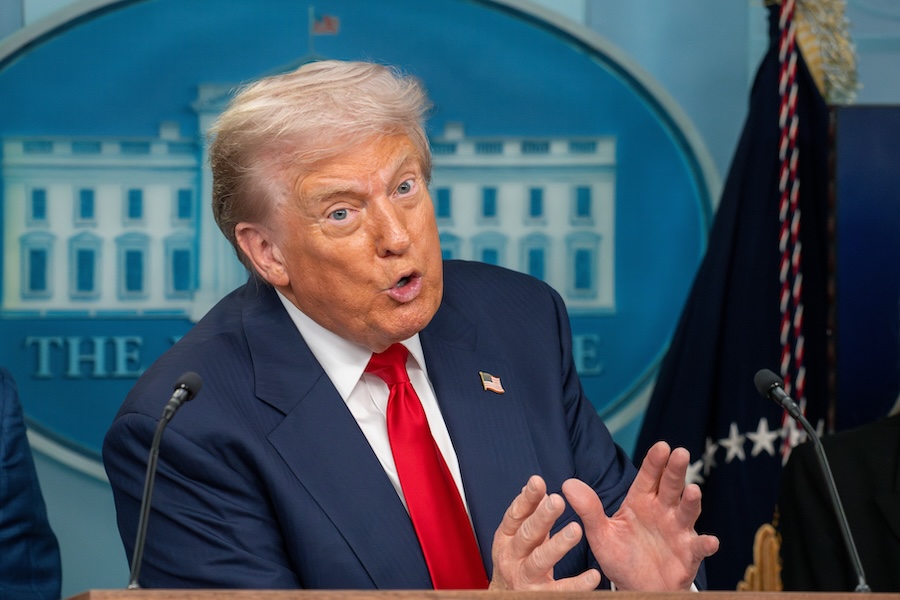
President Donald Trump on Monday revealed new details about a high-risk U.S. military rescue mission deep inside Iran, describing how a wounded American airman survived nearly 48 hours alone in hostile territory before being pulled to safety in a daring operation.
Speaking to reporters, Trump said the downed service member, part of a two-man crew aboard an F-15E Strike Eagle, relied on survival training and instinct after ejecting over Iranian territory. While one crew member was recovered quickly, the second—identified as a weapons systems officer—was left stranded, injured, and surrounded by enemy forces.
“In the United States military, we leave no American behind. We don’t do it,” Trump said during the White House briefing. He praised the rescue team for what he called “a breath-taking show of skill,” saying they were able to recover the “heroic” airman from “treacherous mountain terrain.”
“The heroic F-15 weapons system officer had evaded capture on the ground in Iran for almost 48 hours. That’s a long time when you’re in tough shape and when you’re bleeding,” Trump said.
He added that the colonel had landed a “significant distance” away from the pilot of the F-15E Strike Eagle that was shot down south of Isfahan on Thursday night.
According to details shared by administration officials, the airman suffered injuries during the ejection and crash but was able to move away from the wreckage to avoid detection. He eventually found shelter in a remote mountain area, taking cover inside a cave or narrow crevice while evading Iranian patrols actively searching the region.
The situation quickly became a race against time.
WATCH:
U.S. officials said Iranian forces began sweeping the area shortly after the aircraft went down, raising fears that the airman could be captured if not located quickly. Communication was limited, and American forces had to confirm his identity once contact was established to avoid the risk of a trap.
After nearly 48 hours behind enemy lines, the airman successfully made contact with U.S. forces, allowing planners to launch a full-scale rescue mission.
What followed was a complex and highly coordinated operation involving special operations forces, intelligence assets, and a wide range of aircraft. Trump described it as an “incredible rescue,” noting that multiple layers of deception were used to confuse Iranian forces about the airman’s location.
Trump said the operation involved deliberate deception to throw off adversaries as teams worked to recover the downed personnel.
“We were bringing them all over, and a lot of it was subterfuge,” Trump said. “We wanted to have them think he was in a different location.”
While the effort unfolded overseas, top officials in Washington remained locked in constant coordination, maintaining an open line of communication for nearly 48 hours.
“From the moment our pilots went down, our mission was unblinking,” Defense Secretary Pete Hegseth said. “The call never dropped. The meeting never stopped, the planning never ceased.”
Officials said U.S. forces deployed a large aerial presence, including drones, fighter jets, and support aircraft, to both protect the mission and divert attention away from the actual extraction site. Intelligence support, including advanced surveillance capabilities, played a key role in pinpointing the airman’s location in difficult terrain.
Roughly 100 special operations troops were inserted into the mountainous region under the cover of darkness. Navigating steep and rugged conditions, the team reached the airman and prepared him for evacuation.
The mission, however, did not go entirely as planned.
Mechanical issues with multiple aircraft created tense moments during the extraction phase, raising the possibility that U.S. forces could be temporarily stranded inside Iran. Commanders were forced to adapt quickly, bringing in additional aircraft to complete the mission.
In the end, all personnel were successfully evacuated. Several aircraft that could not be recovered were destroyed on-site to prevent sensitive technology from falling into Iranian hands.
The operation also came under fire. U.S. aircraft supporting the mission reportedly encountered hostile engagement, with at least one plane taking damage during the broader effort to maintain control of the airspace.
