
Politics
BREAKING: SCOTUS Issues Blockbuster Ruling That Could Decide The Midterms

The Supreme Court handed down a blockbuster ruling Wednesday that tightens the rules on race-based redistricting just months before the 2026 midterms, striking down a court’s attempt to force Louisiana to add a second majority-black congressional district.
In a 6-3 decision authored by Justice Samuel Alito, the court ruled that the state’s revised map violated the Equal Protection Clause, finding it was an unconstitutional racial gerrymander even though lawmakers said they were trying to comply with the Voting Rights Act.
Chief Justice John Roberts joined Alito’s opinion, along with Justices Clarence Thomas, Neil Gorsuch, Brett Kavanaugh, and Amy Coney Barrett. Justice Elena Kagan dissented, joined by Justices Sonia Sotomayor and Ketanji Brown Jackson.
The case stems from Louisiana’s post-2020 census redistricting fight. The state’s original 2022 map included one majority-black district. A federal court later ruled that the map likely violated Section 2 of the Voting Rights Act and suggested a second majority-black district was needed.
Facing that ruling, Louisiana lawmakers passed a new map, known as SB8, creating a second majority-black district by linking black populations from Baton Rouge, Lafayette, and Shreveport across a sprawling stretch of the state.
That redraw triggered a new lawsuit, with challengers arguing the map relied too heavily on race.
The Supreme Court ultimately agreed.
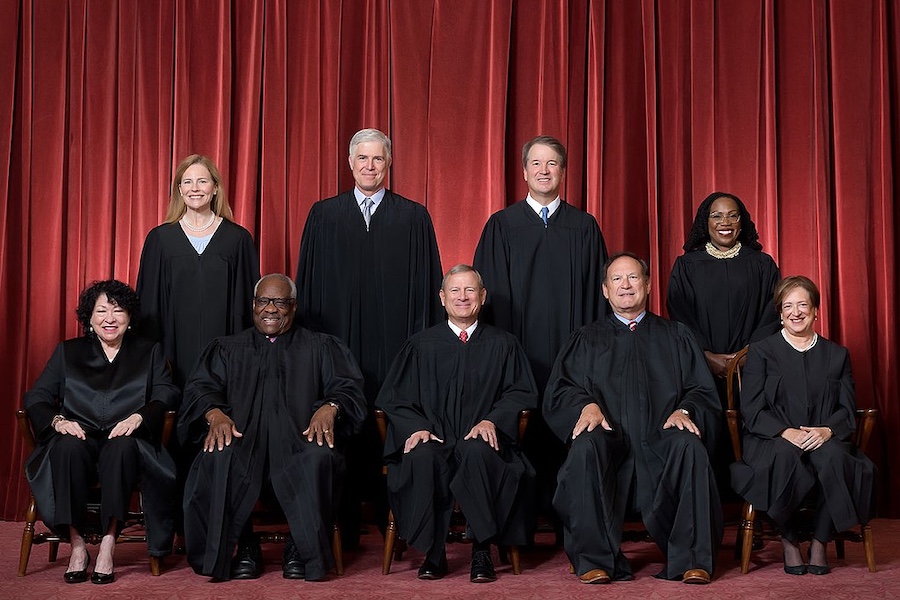
Credit: Fred Schilling, Collection of the Supreme Court of the United States.
“Because the Voting Rights Act did not require Louisiana to create an additional majority-minority district, no compelling interest justified the State’s use of race,” the court held.
The ruling does two key things.
First, the court formally held that compliance with the Voting Rights Act can qualify as a “compelling interest” under the Constitution, something it had only assumed in prior cases. But the justices made clear that standard applies only when the law actually requires race-based action.
Second, the court tightened how Section 2 claims are evaluated. It said minority voters are entitled to an equal “opportunity” to elect candidates of their choice, not guaranteed outcomes or proportional representation.
RELATED: Virginia Supreme Court Issues Major Decision On Dems’ Redistricting Ploy
The opinion also raises the bar for plaintiffs by requiring them to separate race from politics. In states where voting patterns often track party lines, challengers must now show that racial considerations—not partisan goals—drove the map.
That point is likely to carry major implications nationwide.
The court warned that racial gerrymandering claims can be used to “repackag[e] a partisan-gerrymandering claim as a racial-gerrymandering claim,” highlighting concerns that Voting Rights Act lawsuits have been used to fight political battles federal courts can’t otherwise hear.
In Louisiana’s case, the justices said the evidence showed race played a central role in drawing the new district. Lawmakers created District 6 with a majority-black voting-age population specifically to satisfy the earlier court ruling, which triggered strict scrutiny.
But because the Voting Rights Act did not actually require that the second district be under the proper legal standard, the map failed.
The majority also reworked the long-standing “Gingles” framework used in Voting Rights Act cases, instructing lower courts to account for modern political realities, including the overlap between race and party and advances in map-drawing technology.
RELATED: Justices Thomas And Alito Take Opposing Sides In Surprise SCOTUS Ruling
Kagan’s dissent accused the majority of undercutting the Voting Rights Act and making it harder to challenge maps that dilute minority voting power.
The ruling is expected to have immediate consequences as states prepare for the 2026 midterms. It gives legislatures more room to draw maps based on political considerations while limiting when courts can require additional majority-minority districts.
At the same time, it signals that race-based map drawing will face tougher scrutiny unless there is clear, evidence-backed proof that the Voting Rights Act demands it.
The court stopped short of eliminating the use of race in redistricting, but it sharply narrowed when it’s allowed—and that shift could reshape congressional maps across the country heading into a high-stakes election cycle.
Download the FREE Trending Politics App to get the latest news FIRST >>
