
Entertainment
NEW: Huge Earthquake Rocks Yellowstone Just Miles From Supervolcano ‘Overdue’ For Eruption
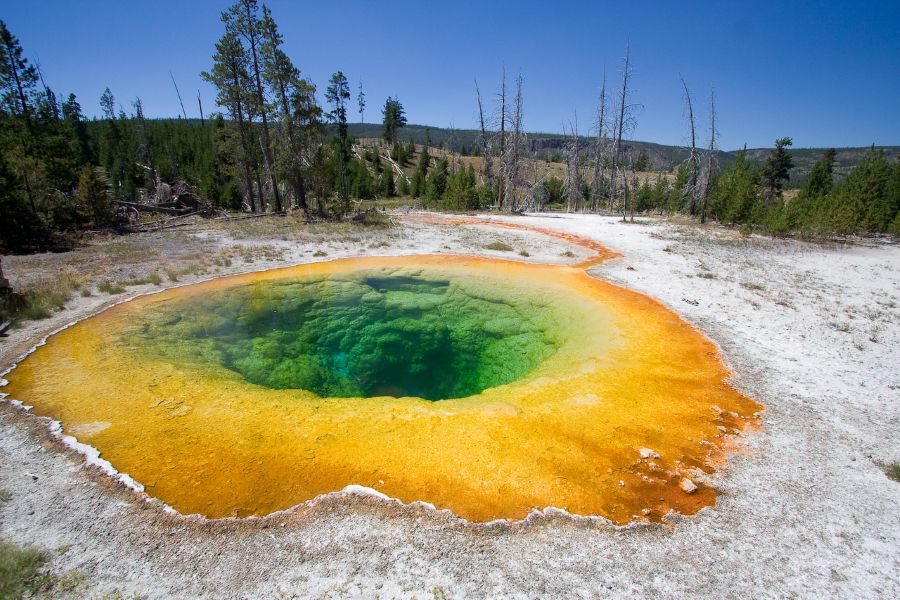
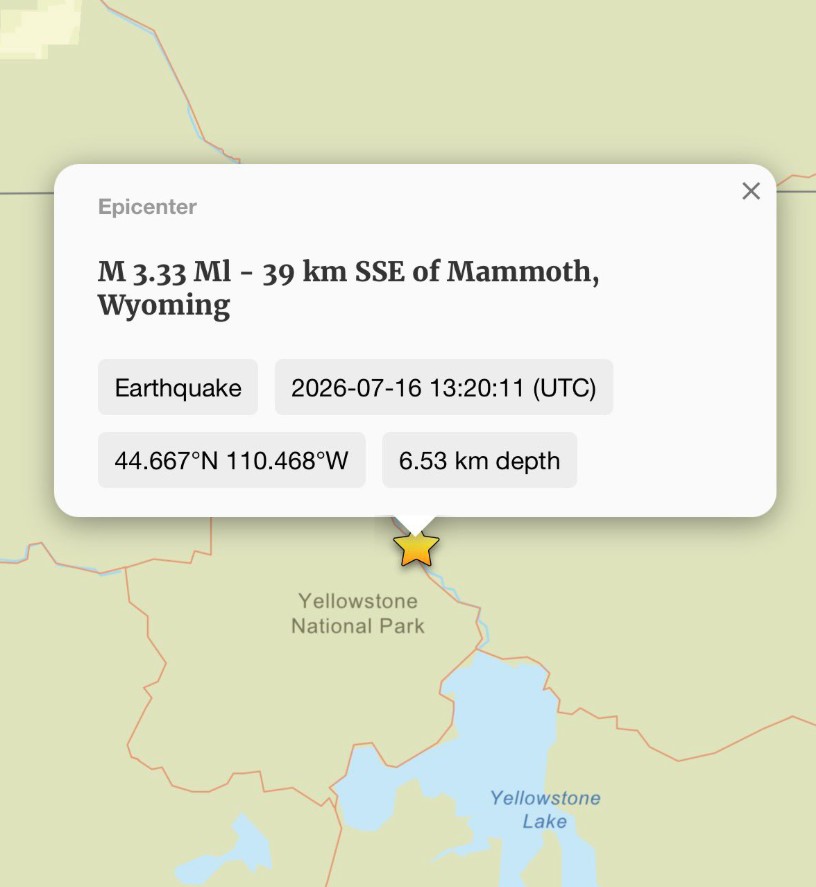
A magnitude 3.3 earthquake rattled Yellowstone National Park on Thursday morning, striking just miles from the famous supervolcano that has fueled doomsday fears for decades.
The U.S. Geological Survey detected the quake at 9:20 a.m. Eastern along the Yellowstone River inside the Wyoming park.
The minor earthquake’s epicenter was recorded roughly seven miles from the Yellowstone caldera, the massive bowl-shaped volcanic depression beneath one of America’s most iconic national parks.
The quake reportedly produced only light shaking across the 2.2 million-acre park, which stretches across Wyoming, Montana and Idaho.
Still, any rumble near Yellowstone is enough to get attention, especially with the ancient volcanic system sitting beneath one of the country’s biggest tourist draws.
In the past three weeks, the USGS has recorded 11 minor earthquakes around the caldera.
Earthquakes are common in Yellowstone, where magma movement, hydrothermal activity and regional tectonic stress all help shake the ground.
The park sits within the Intermountain Seismic Belt, an active fault zone that runs through Nevada, Utah, Idaho, Wyoming and Montana.
Last year, scientists using artificial intelligence found that Yellowstone had been shaking far more often than previously known.
An international research team analyzed 15 years of seismic recordings and identified more than 86,000 tiny earthquakes that human experts had missed.
That was about 10 times the number of quakes researchers had previously counted.
The discovery sharpened scientific understanding of Yellowstone’s underground activity, though it did not mean an eruption was imminent.
USGS has repeatedly pushed back on claims that Yellowstone is “overdue” for a catastrophic blast.
‘In terms of large explosions, Yellowstone has experienced three at 2.08, 1.3, and 0.631 million years ago,’ USGS explained in a statement. ‘This comes out to an average of about 725,000 years between eruptions.’
‘That being the case, there is still about 100,000 years to go, but this is based on the average of just two time intervals between the eruptions, which is meaningless,’ researchers noted.
In other words, Yellowstone is dangerous because it is real, massive and still active.
But it is not a ticking kitchen timer.
A 2025 study by scientists from the University of Utah and the University of New Mexico found that the top of Yellowstone’s underground magma chamber sits about 2.3 miles, or roughly 12,500 feet, below the surface.
Previous estimates had placed the top of the magma system as deep as five miles.
Hot, molten material that close to the surface can create pressure and gases that drive volcanic activity.
But scientists said that does not mean a major eruption is around the corner.
The same research showed Yellowstone is currently stable, with gases venting through the park’s hot springs and geysers rather than building up dangerously underground.
USGS currently lists activity at the Yellowstone supervolcano as ‘normal’ and notes that lava has not erupted from the caldera in 77,000 years.
That has not stopped federal scientists from modeling what a worst-case eruption would look like.
In 2014, USGS projected that a massive Yellowstone eruption could spread ash across the entire United States, with the heaviest fallout near the park.
Yellowstone National Park itself could be buried under more than three feet of volcanic ash in such a scenario.
Nearby cities including Denver, Boise and Salt Lake City could see as much as 40 inches of ash, enough to collapse roofs.
Major cities as far away as Chicago, St. Louis, Kansas City, Los Angeles, San Francisco and Seattle could be coated with an inch of volcanic ash.
That nightmare scenario remains the kind of low-probability, high-impact threat federal agencies monitor closely.
For now, Thursday’s quake appears to be another small tremor in one of the most geologically restless places in America.
Yellowstone is not blowing.
But when the ground shakes next to a supervolcano, people notice.
