
Politics
NEW: Federal Judge Strikes Down Blue State’s Controversial Climate Change Law
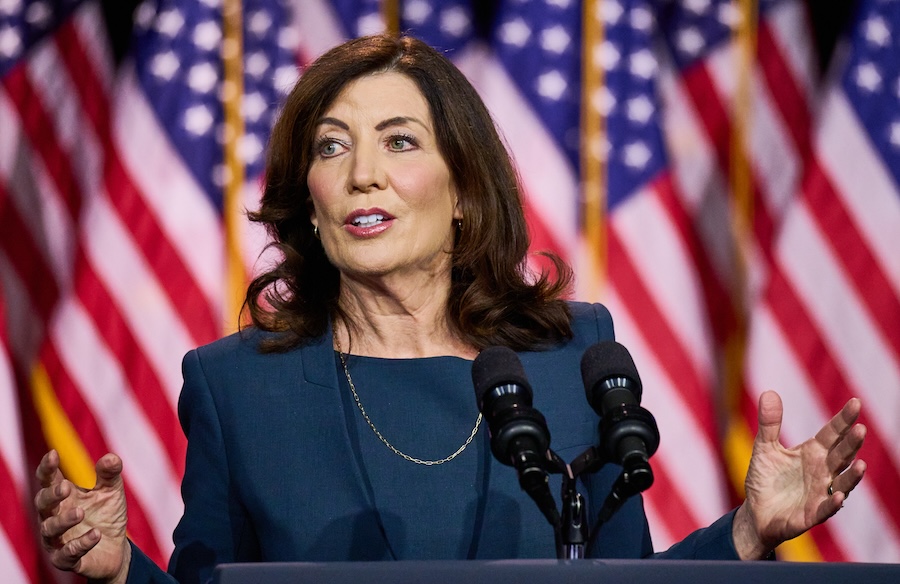
A federal judge on Monday ruled that New York cannot enforce its Climate Change Superfund Act, which seeks to hold fossil fuel companies liable for what the state classifies as effects from climate change.
The law, also known as the Climate Change Adaptation Cost Recovery Program, required certain fossil fuel companies to pay into a state fund. Companies identified by the New York Department of Environmental Conservation as responsible for more than 1 billion tons of greenhouse gas emissions between 2000 and 2018 would have contributed a combined $3 billion annually starting in 2028, for a total of $75 billion over 25 years.
Payments would have been allocated proportionally based on each company’s share of those emissions among designated responsible parties. The funds were designated for infrastructure projects intended to address effects associated with climate change, including upgrades to roads, water and sewage systems, stormwater drainage, transit systems, the electric grid, coastal protections, and measures to mitigate extreme heat.
Sannes wrote that the Clean Air Act, which authorizes the U.S. Environmental Protection Agency to regulate greenhouse gas emissions, does not authorize states to create emissions compensation schemes of this type. She found the statute operates in an area of dominant federal interest.
“The Climate Act is an unusual and sweeping statute, designed to address the effects of climate change–a ‘uniquely international problem of national concern,’” Sannes wrote. “Thus, the Court finds the Climate Act is ‘simply beyond the limits of state law.’” She added: “It is precisely because the Climate Act operates within an area of law in which the federal interest is so dominant that it cannot be enforced.”
Sannes further held that attempts to collect from foreign producers are preempted by the foreign affairs doctrine. The decision relied in part on the 2021 Second Circuit ruling in City of New York v. Chevron Corp, in which the court granted summary judgment to the plaintiffs and held the act invalid and unenforceable.
The current lawsuit was filed in February 2025 by 22 states led by West Virginia, along with industry groups including the U.S. Chamber of Commerce, American Petroleum Institute, and National Mining Association. The U.S. Department of Justice later supported the plaintiffs. Following the ruling, New York officials stated that options are currently being explored.
POLL: Should Migrants Who Murder Americans Face The Death Penalty?
Court strikes down New York law making fossil fuel companies liable for climate change https://t.co/zs7vSPk0Nb
— Just the News (@JustTheNews) September 1, 2026
The Climate Change Superfund Act was signed into law by Governor Kathy Hochul on December 26, 2024, after passing the state Senate in May 2024 and the Assembly in June 2024.
The policy applied a “polluter pays” model, similar to the federal Superfund law for hazardous waste sites. It imposed strict liability on large fossil fuel extractors and crude oil refiners for a portion of New York’s projected costs to adapt infrastructure to weather-related impacts.
Companies did not need to be shown to have broken any law at the time of their past operations, while responsibility was based on the volume of associated historical emissions. The Department of Environmental Conservation was tasked with identifying responsible parties, calculating shares, collecting payments, and directing funds to approved projects, with a portion directed toward “disadvantaged communities.”
RELATED: Supreme Court Rules With Trump In High-Profile Legal Battle
