
Politics
JUST IN: New Poll Shows Abdul El-Sayed Losing Grip On Michigan Senate Race
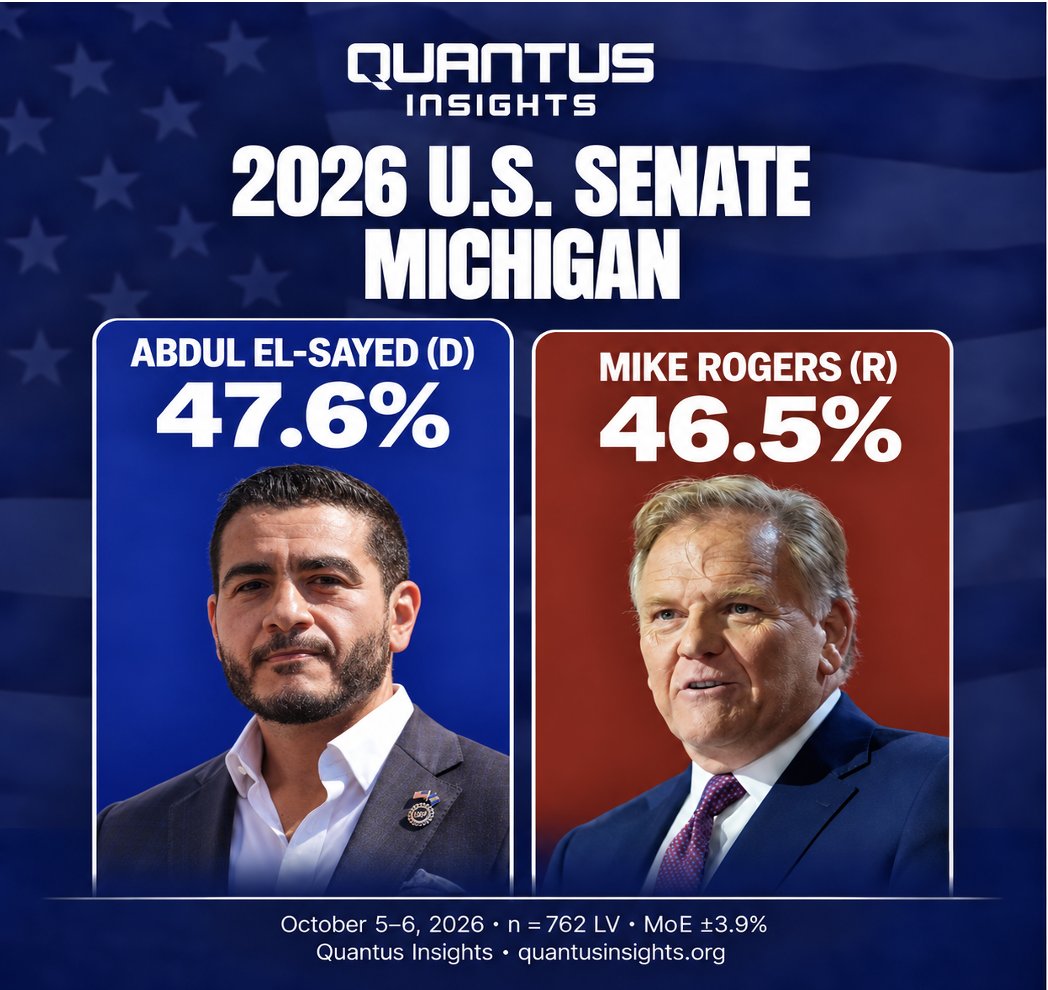
Republican Mike Rogers is within striking distance of Democrat Abdul El-Sayed in Michigan’s Senate race, trailing by just 1.1 percentage points in a new Quantus Insights poll four weeks before Election Day.
The survey puts El-Sayed at 47.6% and Rogers at 46.5%, with 4.2% undecided. Three minor-party candidates draw less than 2% combined.
Quantus surveyed 762 likely Michigan voters Oct. 5-6. The firm reported a margin of error of approximately plus or minus 7.8 percentage points for the difference between the candidates, making El-Sayed’s narrow numerical lead a statistical tie.
The findings put Rogers closer to El-Sayed than the public polling averages cited in Quantus’ analysis, which show the Democrat ahead by roughly 3 to 4 points. El-Sayed’s support in those averages sits near 48%, similar to his showing in the Quantus survey, while Rogers’ support is around 44%.
Quantus cautioned that the difference does not establish that its poll is more accurate or that the race is tightening. Still, the results point to another competitive Michigan contest after Rogers lost to Democrat Elissa Slotkin by three-tenths of a percentage point in 2024.
Suburban voters could prove decisive. They account for 46% of the poll’s sample and favor Rogers 49% to 47%, leaving neither candidate with a substantial advantage in a central battleground.
Rogers’ strongest geographic support comes from rural voters, who make up a quarter of the sample and favor him by 20 points. El-Sayed leads urban voters by 32 points.
The candidates also divide Michigan’s two largest media markets. El-Sayed leads 50% to 43% in the Detroit market, while Rogers holds a 56% to 44% advantage in Grand Rapids. Quantus warned that results from Flint, Lansing and Traverse City should be treated more cautiously because of smaller samples.
Neither candidate gets much additional help when undecided voters are pressed to choose.
POLL: Would You Vote Against ANY Candidate Who Calls Themselves A Socialist?
Of the 31 respondents who initially had not selected a candidate, roughly two-thirds still declined to pick a side. The others split six to five for El-Sayed. Including those leaners brings the result to 48.4% for El-Sayed and 47.2% for Rogers.
Both candidates also face negative overall favorability ratings.
Abdul El-Sayed is viewed favorably by 46.6% of respondents and unfavorably by 48%, a net rating of minus 1.4 percentage points. Rogers stands at 43.8% favorable and 49.4% unfavorable, putting his net rating at minus 5.6 points. Forty-one percent view Rogers very unfavorably.
The poll shows pronounced differences across demographic groups. Women favor El-Sayed 52% to 42%, while men back Rogers 52% to 43%.
Voters younger than 45 support El-Sayed by around 20 points. Rogers leads by 7 to 9 points among older age groups. White voters favor Rogers 52% to 43%, while Black voters back El-Sayed 79% to 15%.
Quantus also examined respondents’ recalled votes in the 2024 presidential election to assess how the sample compared with Michigan’s electorate.
Respondents reported supporting President Donald Trump over Kamala Harris 48.1% to 47%, close to Trump’s certified statewide margin of 1.4 percentage points.
The firm cautioned that voters’ recollections can be imperfect and that matching one election benchmark does not establish that a sample is free of bias. On that measure, however, Quantus found no obvious Democratic tilt to explain El-Sayed’s slight lead.
With the candidates separated by little more than a point and suburban voters closely divided, Quantus’ assessment is that Michigan has no clear favorite heading into the final four weeks.
POLL: Muslim Migration Is At Lowest Levels In Decades … Do You Support This?
