
Politics
NEW: Staggering Shift In Oil Prices Rocks Stock Market

Wall Street took another hit Friday as surging oil prices sent stocks tumbling, raising fresh concerns about inflation, borrowing costs and the growing financial toll of the U.S. war with Iran.
The Dow Jones Industrial Average plunged 541 points, or 1%, by 11:12 a.m. Eastern, while the S&P 500 slipped 0.2%, putting the benchmark index on pace for its second consecutive weekly decline.
The NASDAQ Composite managed a 0.2% gain, thanks largely to technology heavyweights that helped prevent even steeper losses across the market.
But the bigger story was oil.
Brent crude jumped 2.4% to $115.86 per barrel, its highest level since March and a dramatic increase from below $97 at the beginning of October.
The relentless climb is delivering another financial headache for American families already struggling with stubborn inflation and elevated interest rates.
The U.S. conflict with Iran has severely disrupted global oil supplies, pushing energy costs higher and threatening to drive up prices on everything from gasoline and groceries to clothing.
Friday’s market performance reflected those mounting concerns, with approximately three-quarters of the companies in the S&P 500 trading lower.
Industrial giants were among the hardest hit.
Caterpillar dropped 2.3%, while Boeing declined 1%, adding to the pressure on the Dow.
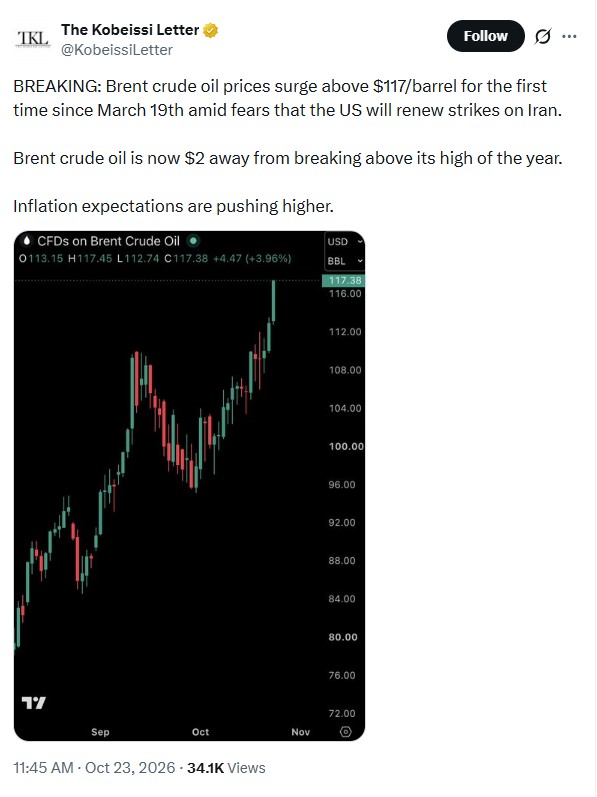
Screenshot-X
Financial stocks also struggled as investors weighed the impact of expensive borrowing and uncertainty surrounding the broader economy.
American Express sank 3.3% despite reporting quarterly profits that exceeded analysts’ expectations.
The credit card company also announced its first significant round of layoffs in approximately a decade, adding another troubling development to an already nervous market.
POLL: Should Barack And Michelle Obama Stay Out Of Politics?
Energy producers, however, benefited from the same oil surge punishing other sectors.
Chevron climbed 2.4%, while ConocoPhillips jumped 4.2%, reflecting the financial advantages higher crude prices can bring to major oil companies.
Meanwhile, artificial intelligence stocks provided some relief.
Micron Technology surged 3.4%, Microsoft gained 0.8% and Nvidia advanced 0.3%.
RELATED: Oil Prices Make New Move Amid Major Developments In Middle East
Those gains helped cushion the broader indexes, although investors remain increasingly skeptical about whether massive AI spending will produce profits sufficient to justify soaring valuations.
Some technology companies have borrowed heavily to finance their AI expansion plans, making higher interest rates an additional burden.
Investors will get a closer look at those investments next week when major technology companies, including Alphabet, Microsoft and Amazon, release quarterly earnings.
The pressure wasn’t limited to American markets.
European stocks also declined, with France’s benchmark index falling 0.7% as investors continued monitoring global economic instability.
In the United States, Treasury yields climbed after Thursday’s sharp decline.
The yield on the 10-year Treasury note rose to 4.99%, up from 4.96% late Thursday.
Higher bond yields can translate into more expensive mortgages, business loans and other forms of borrowing, adding another obstacle for households and businesses.
Inflation remains a major problem for the Federal Reserve, with consumer prices continuing to rise at a pace well above its 2% target.
RELATED: NEW: Trump Strikes Game-Changing Oil Deal With Russia
The central bank raised its benchmark interest rate at its most recent meeting in an effort to contain those pressures.
Wall Street expects policymakers to leave rates unchanged next week, although traders are increasingly anticipating another increase in December.
Another important inflation report could further shake markets.
The personal consumption expenditures price index, the Fed’s preferred inflation gauge, is expected to show a 3.6% annual increase for September.
That would place inflation substantially above the central bank’s target and complicate efforts to bring borrowing costs down.
RELATED: JUST IN: Iran Says A Peace Plan Has Been Sent To US
For President Donald Trump‘s administration, the energy shock presents a difficult economic challenge as the conflict with Iran continues to affect global supply chains.
The immediate concern for investors is whether oil prices will keep climbing, forcing businesses to absorb higher costs or pass them along to consumers.
With corporate earnings, inflation figures and another Federal Reserve meeting approaching, Wall Street faces a critical stretch.
Friday’s sell-off offered a stark reminder that rising oil prices can quickly ripple through the economy, hitting stocks, household budgets and business confidence all at once.
POLL: Will You Support Trump And His Candidates In The Midterms?
