
Politics
AUDIO: Ketanji Brown Jackson Starts Yelling During High Stakes SCOTUS Proceeding
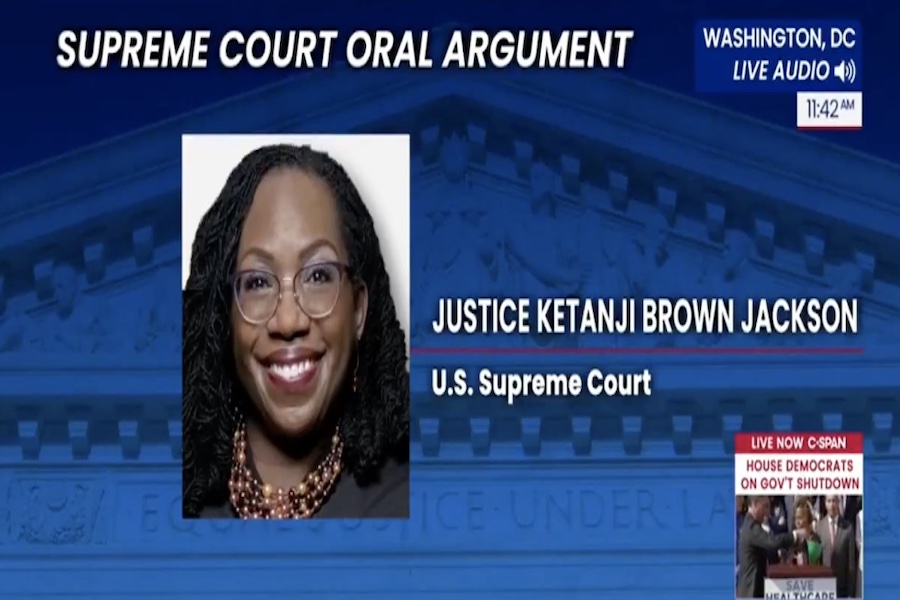
Supreme Court Justice Ketanji Brown Jackson, former President Joe Biden’s lone appointee to the nation’s highest court, repeatedly shouted in multiple heated exchanges as the court heard arguments in a pivotal case concerning the Voting Rights Act of 1965 on Wednesday. The case could have monumental impact on the 2026 midterm elections should the court agree to outlaw the practice of drawing districts on the basis of race.
Expanding upon a Louisiana-based case on the docket, justices said they will consider arguments that the 1965 Voting Rights Act no longer provides a legitimate basis for map creators to intentionally craft majority Black or majority Hispanic districts. The ruling could also impact state and local legislative maps.
The case, Louisiana v. Callais, centers on Louisiana’s congressional map, which features six districts, and challenges the state’s creation of a second majority-Black district under Section 2 of the Voting Rights Act (VRA) of 1965. This provision prohibits voting practices that dilute the electoral power of racial minorities, even if unintentional.
A three-judge federal court previously ordered the creation of a second black majority district in Louisiana, which was then challenged through a lawsuit by white voters in 2024.
During Wednesday’s arguments, Justice Jackson became noticeably agitated in multiple tense exchanges with Benjamin Aguiñaga, the Solicitor General of Louisiana. Jackson was asking the solicitor general about the concept of a “compelling state interest” in the context of identifying and remedying areas where racial discrimination in voting has occurred.
As Aguiñaga began to answer, he was almost immediately cut off by Jackson. “All right, so if I’m right, that Section 2 is about identifying the problem and then requiring some remedy, I don’t understand why your answer to Justice Kagan’s question about is this a compelling state interest is no. The answer is obviously yes, that you have an interest in remedying the effects of racial discrimination that we identify using this tool. Whether you go too far in your remedy is another issue, right?” a seemingly irate Jackson asked.
Aguiñaga responded by stating that “step zero” in the previous case was plaintiffs explicitly asking for “another majority black district,” to which Jackson shot back with another question “I thought they came in and said, we are not receiving equal electoral opportunity because our votes are being diluted.”
The solicitor general then stated that this was essentially saying the same thing, at which point Jackson cut him off once again and started shouting. “No, it’s not,” the justice snapped.
“No, it’s not. Because that, again, just trust me on this. The second electoral or second district is a remedy that one could offer for a problem that we’ve identified. And the whole Robinson litigation was about identifying the problem. Is this really happening? In many, many Section 2 cases, the court says, ‘you’re wrong. You’re fine. There is not an electoral opportunity being denied to you. Go away.’ In this case, the court said, ‘I see. I’m looking at the factors. I appreciate what you’re saying. You’ve proven that we have this problem.’ And so the next question is, how do we go about remedying it?”
Aguiñaga once again attempted to respond, but was again cut off by Jackson before the line of questioning ended abruptly.
A decision limiting the ability to create majority-minority districts to comply with the VRA could weaken Section 2 protections nationwide, affecting redistricting in a number of states. The conservative Supreme Court majority has historically been skeptical of race-based policies, and Justice Clarence Thomas has openly questioned the constitutionality of Section 2 in redistricting.
Depending on scope, a definitive ruling could also have a massive effect on redistricting efforts nationwide. Scaling back VRA power could allow Republican-controlled states to further dilute Democrat-held districts, though it could also run the risk of spreading out Democrat voters and in effect, making “safe” seats under current maps more competitive.
RELATED: Leftist Arrested With 200 ‘Grenades’ In Suspected Assassination Plot Against SCOTUS Conservatives
