
Politics
Cartel Retaliation Leaves 25 National Guard Troops Dead After Killing Of El Mencho
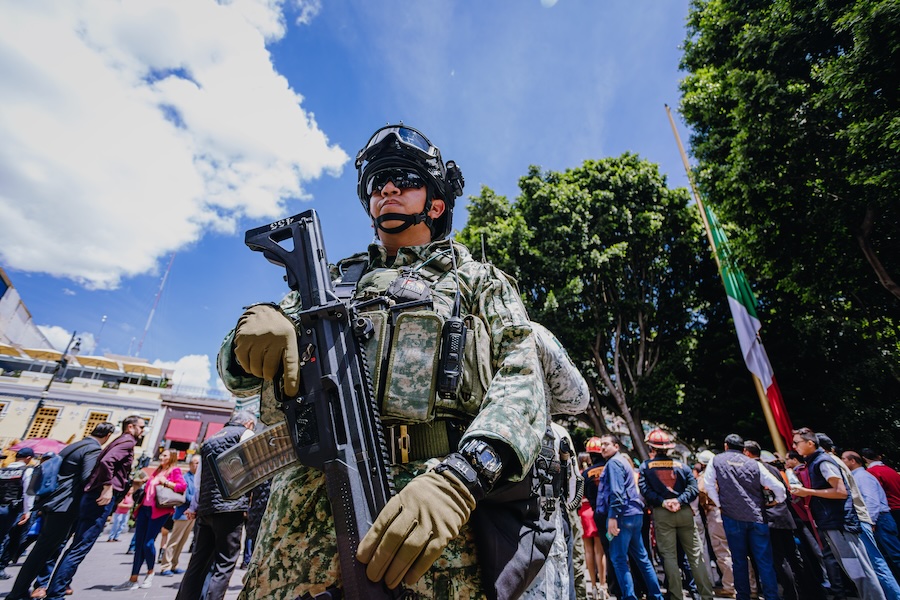
The killing of one of Mexico’s most powerful cartel leaders set off a wave of coordinated violence that left at least 25 members of the Mexican National Guard dead and plunged several western states into days of unrest.
Mexican authorities confirmed that Nemesio Rubén Oseguera Cervantes, widely known as El Mencho, was killed during a military operation in the mountainous municipality of Tapalpa in Jalisco state. Oseguera Cervantes led the Jalisco New Generation Cartel, or CJNG, an organization that rose over the past decade to become one of the most heavily armed and territorially expansive criminal groups in the country.
Within hours of the announcement of his death, cartel gunmen launched coordinated reprisals across Jalisco and neighboring states. Highways were blocked with burning trucks and buses. Businesses were set ablaze. Gun battles erupted between security forces and armed civilians in multiple municipalities.
Mexico’s Security Secretary, Omar García Harfuch, said at least 25 National Guard members were killed in six separate confrontations tied to the retaliation. Several additional officers were wounded. The attacks represented one of the deadliest single days for federal forces in recent years.
The scale of the violence exposed both the operational capacity of the CJNG and the risks that often follow the removal of a dominant cartel leader. Analysts have long warned that leadership decapitations can splinter organizations, prompting internal power struggles or aggressive demonstrations of strength designed to project continuity.
WATCH:
🚨 BREAKING: Sen. Bernie Moreno just called on Mexico to request U.S. MILITARY BACKUP in immediately decimating the cartels as CHAOS breaks out in several locations
Cartel militants are livid after one of their leaders was killed.
FINISH THEM, MEXICO!
— Eric Daugherty (@EricLDaugh) February 22, 2026
In Guadalajara, the state capital and one of Mexico’s largest metropolitan areas, schools were closed and public transportation was suspended as authorities worked to clear barricades. Plumes of smoke rose from torched vehicles positioned across major thoroughfares. Residents reported hearing gunfire into the night.
In coastal areas including Puerto Vallarta, a major tourist destination, flights were delayed or canceled amid security concerns. The United States issued shelter in place guidance for government personnel in affected regions, citing rapidly evolving conditions on the ground.
President Claudia Sheinbaum said federal forces would remain deployed in large numbers until order was restored. She characterized the operation that killed Oseguera Cervantes as the result of months of intelligence work and coordination between military and civilian security agencies. Officials declined to detail the extent of any foreign assistance but acknowledged longstanding cooperation with American authorities in targeting high value criminal figures.
WATCH:
🚨 BREAKING: The cartels are actively DESTROYING civilian sites in Mexico after security forces killed cartel kingpin El Mencho
Mexico should IMMEDIATELY request overwhelming U.S. military support and exterminate the cartels NOW.
END THIS!
pic.twitter.com/G51Itm5u2z— Eric Daugherty (@EricLDaugh) February 22, 2026
In Washington, President Donald Trump called the killing a significant blow to transnational organized crime and urged continued pressure on cartel networks that traffic fentanyl and other narcotics into the United States.
The CJNG emerged in the early 2010s from the remnants of other criminal groups and quickly distinguished itself through brazen tactics and paramilitary style displays of force. It expanded its reach into port cities, rural production corridors and key smuggling routes. Authorities have linked the organization to large scale drug trafficking, extortion, kidnapping and attacks on police and military targets.
Security experts say the immediate challenge for Mexican authorities is to prevent further bloodshed while managing the potential fragmentation of the cartel’s command structure. Rival factions could compete for control of territory and revenue streams, raising the risk of additional clashes.
