
Politics
Chicago Man With 72 Arrests Was Released By Dem Judge Before Intentionally Setting Woman On Fire

The attacker who set an unsuspecting 26-year-old woman on fire in a horrific act of unprovoked violence aboard a Chicago train was released by a Cook County judge back in August despite despite prosecutors petitioning him to remain behind bars.
Lawrence Reed, 50, had racked up an astonishing 72 total arrests before carrying out the vicious attack on November 17. Reed allegedly approached a 26-year-old woman who was sleeping, doused her with a liquid from a silver can (believed to be a flammable accelerant), ignited her with a lighter, and then calmly walked away as she burned.
The woman suffered burns across nearly 60 percent of her body and remains hospitalized in critical condition after multiple surgeries.
Reed was arrested shortly afterward, initially charged with attempted first-degree murder at the state level, and on November 19 was federally charged with one count of terrorism.
The suspected attacker, who is homeless, had a lengthy criminal history that included an astonishing 72 arrests before the attack was carried out. Some of his most serious prior charges and convictions include arson — notably a 2020 felony arson for setting fire to a government building –aggravated battery, drug possession, criminal damage to property, and multiple theft-related offenses.
He was most recently in court this past summer, when he was released by Cook County Judge Teresa Molina-Gonzalez on August 22, according to a report from CWB Chicago.
Molina-Gonzalez freed Reed on a felony aggravated battery charge for allegedly slapping a social worker at MacNeal Hospital. The August 19 assault was reportedly so vicious that the worker was knocked unconscious.

Lawrence Reed, 50, spent time in prison on an arson conviction before allegedly carrying out the attack
Prosecutor Jerrilyn Gumila had warned the judge that Reed was a danger to the community given his documented history of violence, warning that electronic monitoring was not sufficient.
Under Illinois’ Pretrial Fairness Act, judges cannot hold a defendant in detention unless they are charged with a felony and meet a range of additional criteria, including having a criminal history, posing a risk of endangering the community or being a flight risk.
“It could not protect the victim or the community from another vicious, random, and spontaneous attacks,” Gumila told the judge during an August 22 detention hearing in a Maywood court, CWB Chicago reported. The prosecutor described how surveillance footage of the August 19 assault showed how quickly Reed become violent as the worker was speaking to him in the hospital’s psychiatric ward.
He “became irate and slapped the victim in the face with an open palm,” Gumila said. “Her vision went black, and she lost consciousness for several seconds. One of the victim’s co-workers rushed over and helped the victim walk down to her office, and the victim was then taken to the emergency room.”
The social worker suffered multiple injuries as a result of the attack, including a cut on the cornea of her eye, possible optic nerve bruising, a concussion that caused her nausea and memory loss and a chipped tooth, the prosecutor added.
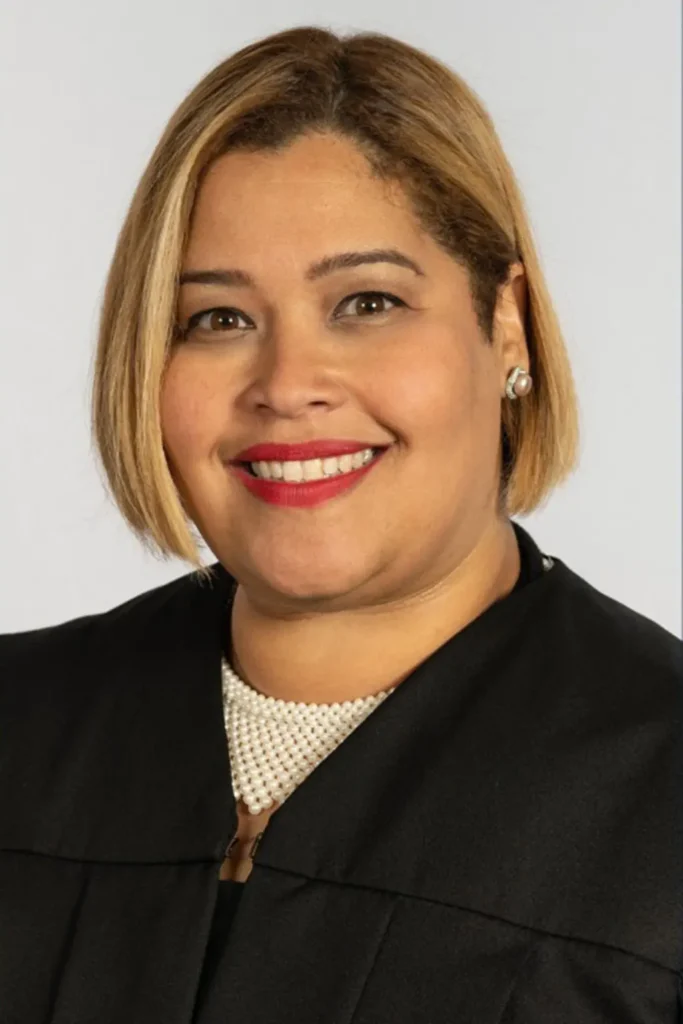
Cook County Judge Teresa Molina-Gonzalez
Gumila also listed Reed’s extensive criminal history, including the 2020 arson conviction, during the detention hearing. “The defendant poses a real and present threat to the safety of, especially this victim, whoever else was working in the hospital that day, and the community as a whole,” Gumila told the judge.
“The defendant randomly and spontaneously became irate in this situation where the victim was just attempting to do her job as a social worker, and now as a result, suffered injuries so severe that she still has side effects on a daily basis.”
Reed’s attorney, Nicholas Yannias, blamed his client’s behavior on a documented history of mental illness, adding that he is now back on the same medication schedule he was on prior to the assault. “Mr. Reed needs services, he does not need to be incarcerated for being mentally ill and acting in accordance with his mental illness,” the lawyer said.
Judge Molina-Gonzalez told Gumila, “I understand your position, but I can’t keep everybody in jail because the state’s attorney wants me to, but I understand and respect your position.”
The judge ultimately released Reed under electronic monitoring on the condition that he did not visit the hospital unless he has a genuine medical emergency, “because of your ridiculous criminal history and lengthy criminal history.”
She allowed him to leave his home 40 hours a week — 24 hours more than the 16 allotted under the state’s SAFE-T Act permitting defendants with electronic monitoring to leave home 16 hours a week for “essential” activities. A few weeks later on September 12, Judge Ralph Meczyk approved Yannias’ request allowing Reed out for different hours so that he would “be able to do church activities,” the New York Post reported.
The assault charge stemming from the August 19 attack was upgraded to a felony a week later on September 19. Court records filed in the most recent case further indicate that Reed violated his curfew on numerous occasions leading up to the train attack.
The Trending Politics News app is your home for breaking updates. Download it today!
