
Politics
Federal Judge Refers Philly DA Larry Krasner To DOJ For Criminal Investigation
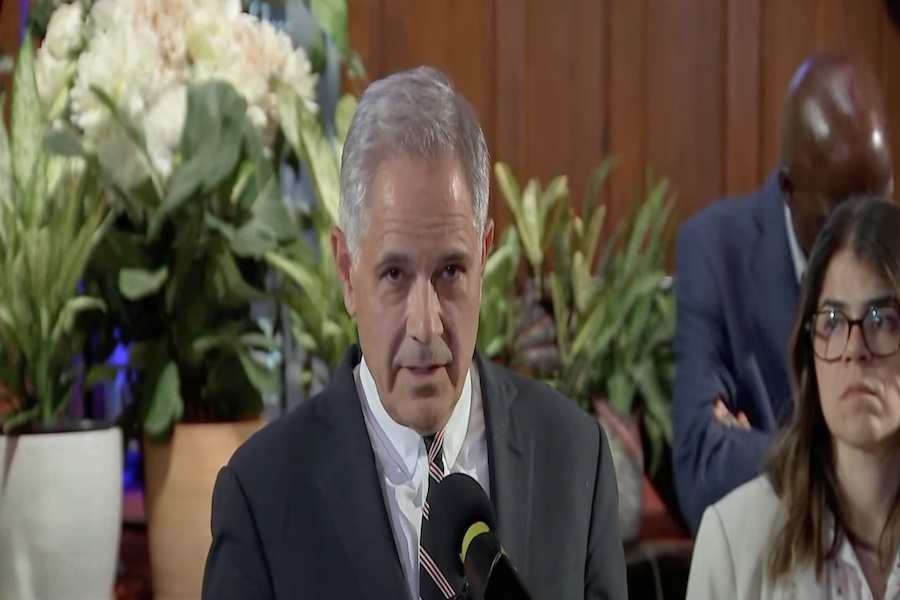
U.S. District Judge Paul S. Diamond on Tuesday, September 15, issued a memorandum referring Philadelphia District Attorney Larry Krasner, Assistant District Attorney Matthew Stiegler, and the Philadelphia District Attorney’s Office to the U.S. Attorney’s Office for the Eastern District of Pennsylvania. The referral concerns possible violations of law arising from the office’s handling of a federal habeas corpus petition filed by Dennis Johnson.
Johnson was convicted in 2009 of second-degree murder in the August 17, 2007, shooting death of Kenyatta Smith outside a convenience store near 30th Street and Lehigh Avenue in North Philadelphia. He has sought to overturn the conviction in federal court.
In 2022, the District Attorney’s Office filed a response stating that Johnson was entitled to habeas relief based on ineffective assistance of counsel. That filing later was described as containing errors and material misstatements.
Judge Diamond began holding evidentiary hearings in May 2026 to examine how the 2022 concession was prepared and to address questions of conflicts of interest within the office. Testimony came from several current and former prosecutors, including Katherine Ernst, Steven Wildberger, David Napiorski, and Jaclyn Mason, who had prepared the original concession and later resigned.
Four employees rejected a proposal they viewed as inappropriate and recommended that the matter be referred to the Pennsylvania Attorney General’s Office because of conflicts involving Stiegler, who had supervised the work.
POLL: Should Migrants Who Murder Americans Face The Death Penalty?
U.S. District Judge Paul S. Diamond said he believed Krasner and one of his top supervisors, Matthew Stiegler, may have committed perjury, conspiracy, or obstruction of justice. https://t.co/FXT4OzTmt1
— The Philadelphia Inquirer (@PhillyInquirer) September 15, 2026
According to the memorandum, Krasner opposed referring the case to the Attorney General’s Office, stating that the District Attorney’s Office needed to remain involved to “protect the office.” Prosecutors who testified said they viewed that directive itself as creating a conflict, because their obligation was to the merits of the case rather than the institutional interests of the office. The judge wrote that Krasner and Stiegler sought to attribute responsibility for the flawed concession to Mason and to characterize her as a rogue attorney.
Judge Diamond found that the office had a conflict of interest but stated he lacked authority to order a referral to the attorney general. He disqualified Krasner and Stiegler from further personal participation in the Johnson matter while allowing other attorneys from the District Attorney’s Office to continue. He described the testimony concerning Krasner’s and Stiegler’s actions as “troubling” and “disturbing.”
“I have thus reluctantly concluded that Philadelphia’s highest law enforcement official and one of his top assistants may have violated the law,” the judge wrote in the 40-page memorandum. “In these circumstances, with the issuance of this Memorandum, I refer the DAO, Mr. Krasner, and Stiegler to this District’s United States Attorney’s Office for investigation and other appropriate action,” he added.
The possible offenses identified include false statements, perjury, obstruction of justice, and conspiracy. “Mr. Krasner does not wish to give this Court a truthful account of how the Concession came to be even though his duty to the Court requires him to do so,” Diamond wrote.
RELATED: Larry Krasner Threatens To ‘Blow Up’ White House Ballroom
