
Politics
Iran Mocks ‘Ceasefire’ Report With Chilling Threat
Iran slapped down talk of a ceasefire Monday, taunting President Donald Trump after he said the U.S. would pause strikes on Iranian energy infrastructure following what he described as “very good” peace talks.
An Iranian official told Fars News Agency, which is aligned with the Islamic Revolutionary Guard Corps, that there is “no direct or indirect contact with Trump.”
The unnamed source claimed Trump backed down after “hearing that our targets would include all power stations in West Asia.”
Iran’s rhetoric didn’t stop there. Iranian Major General Abdollahi warned: “The use of a new, secret weapon will begin soon and it will bring an end to the enemy’s operations.”
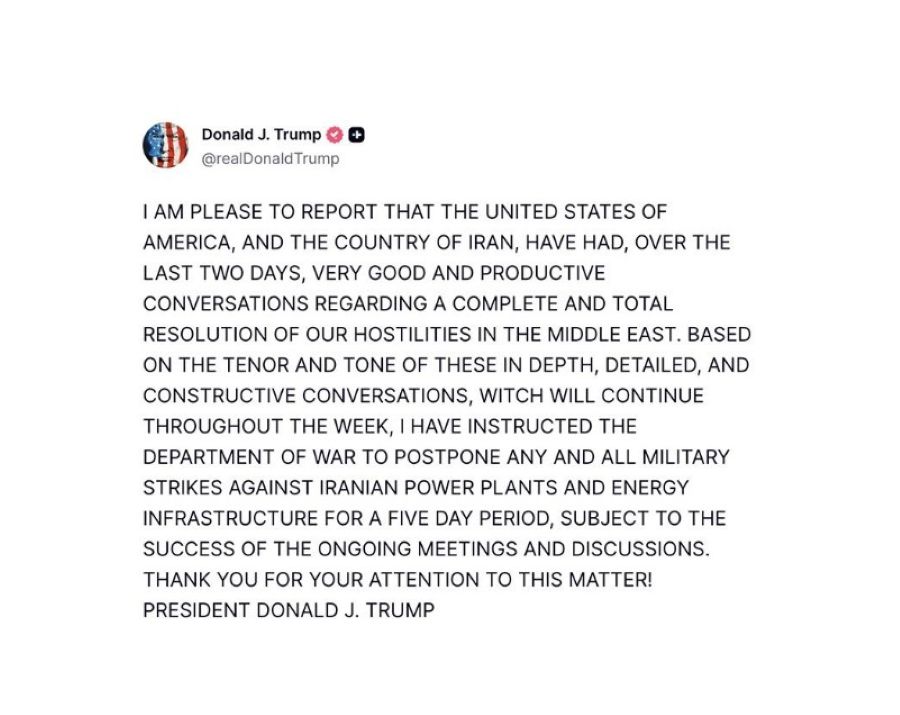
The comments landed minutes after Trump said the two sides had held “productive conversations regarding a complete and total resolution of our hostilities.”
Markets immediately whipsawed on the headline. Brent crude, the global benchmark, swung from about $92 a barrel to as high as $103 in chaotic trading. The Dow swung 700 points before the opening bell and was last up around 1.4%.
Trump said he had ordered the Pentagon “to postpone any and all military strikes against Iranian power plants and energy infrastructure” for five days, speaking to Fox Business and CNBC on Monday morning. He warned the pause was “subject to the success of the ongoing meetings and discussions.”
The back-and-forth comes after Trump threatened over the weekend to bomb Iran’s electricity grid unless Tehran reopened the Strait of Hormuz within 48 hours. Iran ignored the deadline and instead vowed to strike water and energy facilities across the region.
🇺🇸🇮🇷 Iranian Foreign Ministry:
“We deny what US President Donald Trump said regarding negotiations taking place between the United States of America and the Islamic Republic of Iran.
The Islamic Republic of Iran adheres to its position rejecting any type of negotiations before…
— The Daily News (@DailyNewsJustIn) March 23, 2026
Iranian authorities also warned they would deploy naval mines across the Gulf on Monday if the U.S. attempted to invade its coastline or islands, a fresh signal that Tehran is leaning into the one pressure point it still has.
RELATED: Trump Hints At Escalation In Middle East: ‘Any Time We Want’
Iran’s closure of the Strait of Hormuz since the start of the war has helped trigger a global energy squeeze. Gas prices have surged to an average of $4.00 a gallon nationwide, up from $2.90 before the conflict began three weeks ago. The narrow strait, through which roughly a fifth of the world’s oil flows, remains snarled by the threat of mines and missiles.
Trump has previously threatened to use U.S. troops to seize Kharg Island, a small, rocky outpost in the Persian Gulf tied to Iran’s oil exports. But Tehran has not promised to reopen the passageway, and its stranglehold on Hormuz remains its biggest leverage in the conflict.
RELATED: JUST IN: Trump Gives Final Ultimatum On Iran Conflict
It is still unclear what any ceasefire framework would actually cover, or how Israel would factor into the discussions. U.S. and Iranian diplomats have repeatedly collided over Tehran’s ballistic missile program, nuclear enrichment and the regime’s remaining stockpiles, the very issues now sitting under the shadow of war.
Download the FREE Trending Politics App to get the latest news FIRST >>
