
Entertainment
‘Irrefutable Proof’: Noah’s Ark Could Finally Be Found After New Development
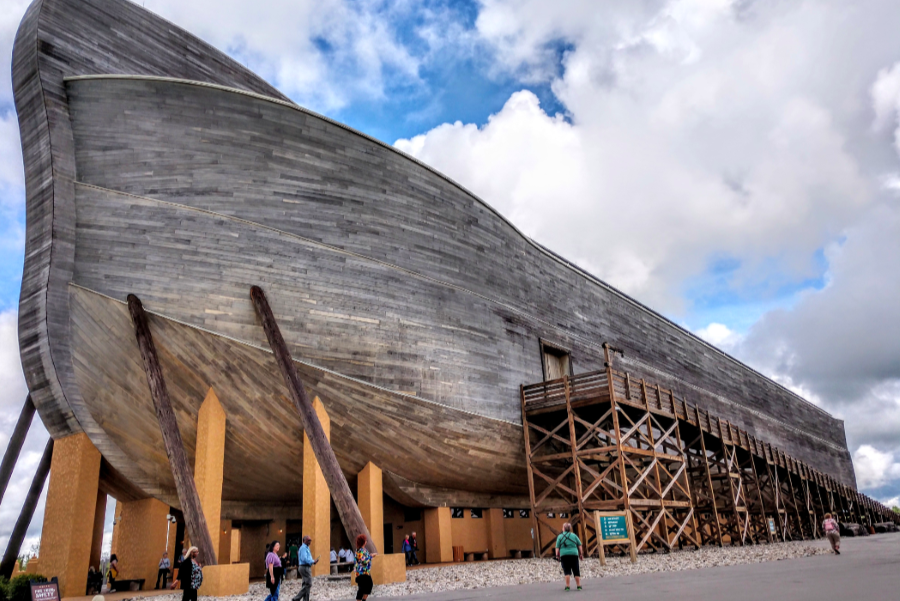
A mysterious boat-shaped formation in the mountains of eastern Turkey could soon face its biggest test yet, as researchers who believe it may be the final resting place of Noah’s Ark say they have received official approval to investigate the site.
The team behind Noah’s Ark Scans announced that its Turkish partner secured government permits for what the group describes as the most comprehensive scientific study ever conducted at the Durupinar Formation near Mount Ararat.
The expedition is expected to include non-destructive core drilling, advanced remote-sensing technology, next-generation imaging systems and an underground drone named “Gopher” designed to map what is buried beneath the surface.
In announcing the approval, the group said it hopes to provide the world with “irrefutable proof” that the formation is the authentic resting place of Noah’s Ark.
Researchers with the group have previously used ground-penetrating radar to scan more than 20 feet below the site, where they say they identified angular structures, hidden voids and right-angle formations that do not appear consistent with ordinary geology.
Noah’s Ark Scans fundraiser Lauren Witzke said: ‘This is not merely a scientific expedition; this is confirmation that one of the most scoffed-at stories in history, Noah’s Ark, is real, as is the God who inspired it and, in His wrath and mercy, sent the flood for which it was needed.’
The expedition is scheduled to begin later this year, with preliminary findings expected to be released as data is processed and verified.
The authorization marks a major development for researchers who have spent years arguing that the site deserves serious investigation instead of dismissal from skeptics.
‘This historic authorization marks the first time in modern history that a dedicated international team has been officially cleared to perform extensive, non-destructive investigations at the site using revolutionary new scanning and imaging technologies never before applied to this site,’ the team shared in the release.
The Durupinar Formation sits about 18 miles south of Mount Ararat, Turkey’s tallest peak, and has been known to the modern world for less than a century.
According to local reports, heavy rain and earthquakes in May 1948 washed away surrounding mud and exposed the strange formation, which was then discovered by a Kurdish shepherd.
The Bible says Noah’s Ark came to rest on the “mountains of Ararat” after a 150-day flood that covered the Earth and destroyed every living creature not sheltered inside the wooden vessel.
The resting place of Noah’s Ark has been found, and archaeological researcher Andrew Jones has been work tirelessly for years to show this to the world. pic.twitter.com/IVboNAD8Nn
— Noahs Ark Scans (@noahsarkscans) April 18, 2026
The site has drawn attention because of its shape, location and measurements, which researchers say appear to line up with the biblical description of the ark.
Biblical measurements describe the ark as 300 cubits long, 50 cubits wide and 30 cubits high, or roughly 515 feet long, 86 feet wide and 52 feet tall.
The measurements of the Turkish formation appear to match those dimensions, according to researchers backing the theory.
Still, the site has long been controversial.
Many scientists argue the formation is a natural geological feature, while believers and independent researchers say the unusual radar readings and soil data point to something far more extraordinary.
The Noah’s Ark Scans team is firmly in the second camp.
Jones previously told the Daily Mail: ‘Naturally, an object would not form this way with the pointed end uphill,’ said Jones.
‘Per fluid dynamics, if this was an obstruction naturally forming around a rock in the earth or mud flow, then the pointed end would be downhill and the rounded end would be uphill.’
FOR IMMEDIATE RELEASE:
Noah’s Ark Scans is thrilled to announce that we have just received a landmark UNANIMOUS vote of approval from Turkish officials to launch the most advanced scientific expedition at the Durupınar boat-shaped formation ever conducted in history.
We… pic.twitter.com/F5QcVCxYVo
— Noahs Ark Scans (@noahsarkscans) June 17, 2026
Jones said the team has also identified a tunnel leading to a large central void beneath the formation.
Jones added that he and his team have uncovered a tunnel that is not filled in, which leads to a big central void, a room that goes much further down that is square shaped.’
‘Some people have theorized that Noah’s Ark had a multi-level big atrium to let the light and air circulate between the three decks,’ said the researcher.
Researchers also say soil samples taken inside the formation differ from those outside it.
Jones said the soil inside the formation is less alkaline, contains more organic matter and has more potassium, which the team argues is consistent with decaying wood from an ancient vessel.
‘Tests show these soil differences (pH, organic matter and potassium) are real, with less than a five percent chance they’re random, giving 95 percent confidence that something like a decayed wooden ship is causing them,’ he added.
Using ground-penetrating radar, the team says it has detected what appear to be long hallways running through the center and sides of the boat-like formation.
The void first appears about 14 feet below the surface and stretches more than 39 feet, according to the scans.
Jones said the space extends from the center of the structure toward its tip, ending where a large boulder was detected.
‘The tunnel then drops another 26 feet, connecting to a massive central room that we’re seeing in the radar scans,’ he said.
‘Our assumption is that this could be part of Noah’s Ark, possibly the central hall and some of the decks. There’s definitely something preserved underground.’
Jones suggested the tunnel could have served as a main hallway, giving access to rooms meant for animals aboard the vessel.
He also argued that the biblical wording supports the Durupinar site because it refers to a region, not necessarily one specific mountain peak.
‘In the Biblical account, it doesn’t say Noah’s Ark landed on Mount Ararat; it says the mountains, plural, of Ararat,’ Jones explained.
‘Back in those days, Ararat was an ancient kingdom. So it would be like saying today that Noah’s Ark landed in the mountains of Colorado. It’s referring to a region of mountains, not one specific peak, and our site fits within that location.’
Another possible location often cited by ark hunters is the top of Mount Ararat itself, though researchers have not found definitive evidence there.
Christian tradition has identified Mount Ararat in modern-day Turkey as the ark’s resting place since at least the fourth century.
Josephus, a first-century Jewish historian, also wrote that remains of the ark were still visible in the mountains of Armenia, helping cement the association with the Ararat region.
For skeptics, the upcoming work may simply confirm that the Durupinar Formation is a strange natural feature.
For believers, it could become one of the most stunning archaeological and biblical discoveries in modern history.
Download the FREE Trending Politics App to get the latest news FIRST >>
