
Entertainment
Jane Goodall Passes Away At 91
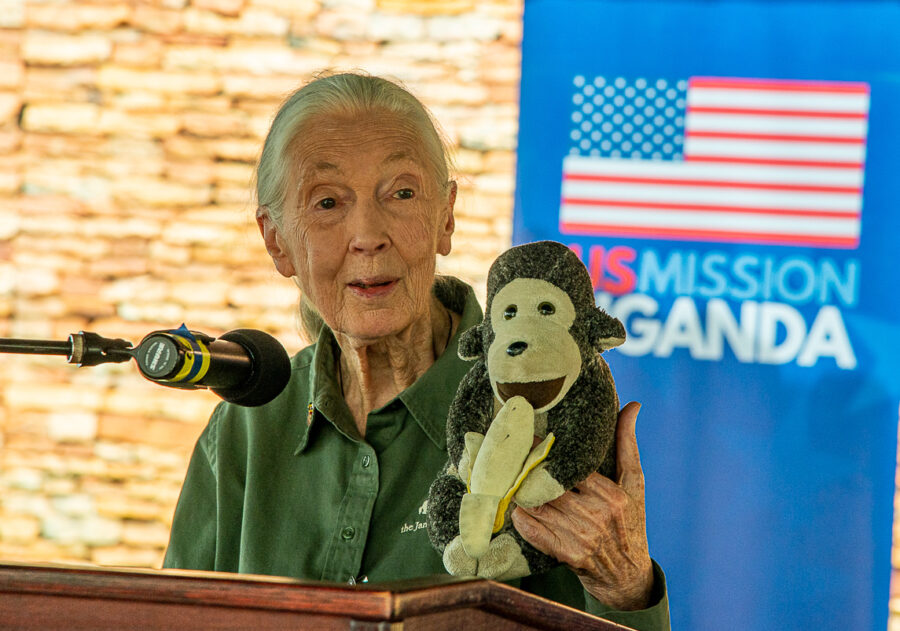
Legendary wildlife conservationist Jane Goodall passed away at age 91, according to the conservation organization she launched decades ago and which spanned most of her time in the public spotlight advocating for chimpanzees and other primates.
Goodall died of natural causes on Wednesday while in California on a cross-country speaking tour, the The Jane Goodall Institute announced.
“Dr. Goodall’s discoveries as an ethologist revolutionized science, and she was a tireless advocate for the protection and restoration of our natural world,” the organization said in statement on social media.
The primatologist and anthropologist broke ground in her fields with unparalleled studies into the social order of chimpanzees in the 1960s, paving the way for increased recognition of the species that shares 99% of its DNA with humans.
She was among a handful of individuals to carry global celebrity status for heralding the many profound behaviors of homo sapien’s closest cousin, including the use of tools for foraging, eating meat, and engaging in organized warfare.
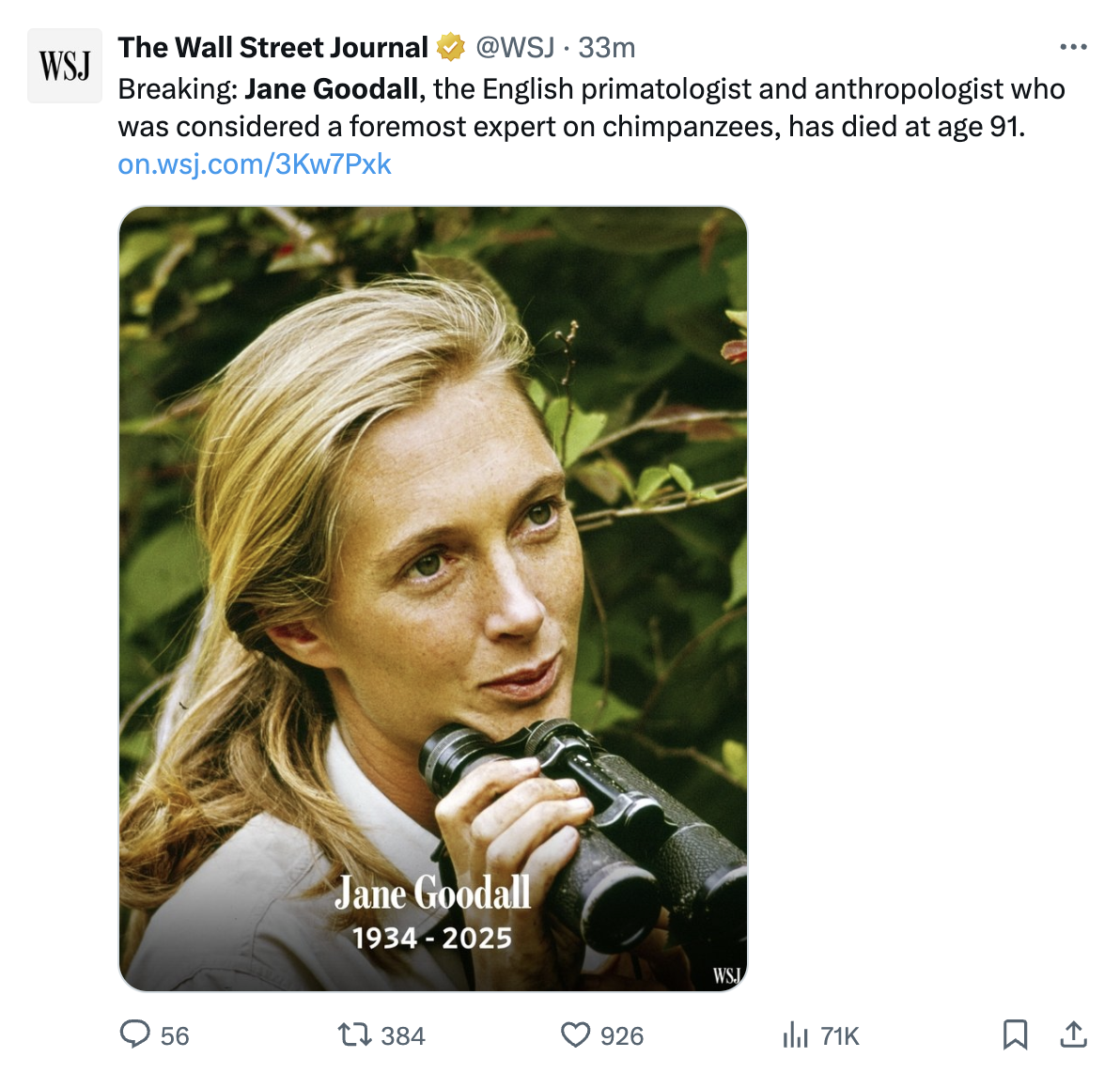
The British-born Goodall published her seminal work in 1963 when she reported on a tribe of chimpanzees in Tanzania, describing her harrowing struggles with disease and destitution alongside Dutch photographer Hugo van Lawick, whom she later married.
The 7,500 word thesis exposed previously unknown facets of chimpanzee behavior, including the rearing of their young, established hierarchies of leadership, and methods of communication.
Stephen Jay Gould, the famed evolutionary biologist, praised Goodall’s research as “one of the Western world’s great scientific achievements.”
For the first time, Goodall produced evidence that chimpanzees, which diverged from humans between 6 and 9 million years ago, are capable of complex instrumentation, including the insertion of sticks into anthills to set traps.
Louis Leakey, Dr. Goodall’s mentor, remarked on the historic nature of her publication, “Now we must redefine ‘tool,’ redefine ‘man,’ or accept chimpanzees as humans.”
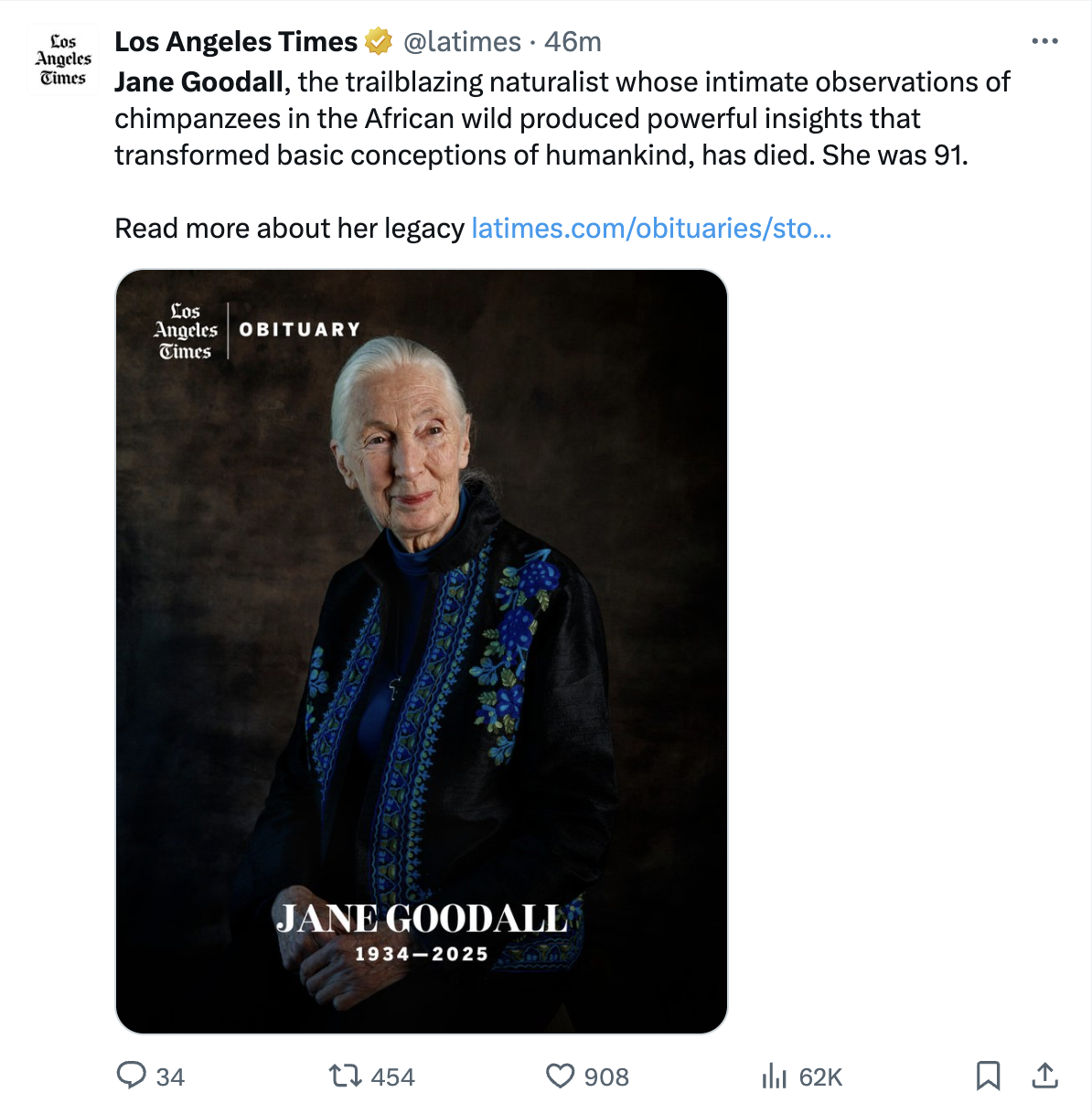
Society’s imagination of evolution, given birth through the rise of research by Charles Darwin and Alfred Russel Wallace, intertwined with Goodall’s notoriety to catapult her research into the mainstream. She authored several books tailored to children and laymen, including “My Friends, the Wild Chimpanzees” (1967), “In the Shadow of Man” (1971) and “Through a Window” (1990).
Her demeanor and telegenic ease made her irresistible to broadcasters eager to portray Goodall’s global exploration at a time when increasing numbers of women were entering the workforce.
She was elevated further by a 1965 feature on CBS where Goodall described key elements of maternal care among chimpanzees in the wild, contrasting the reticent nature of young mothers with older, more experienced female primates who openly displayed their children for males, satisfying their curiously and quelling unrest over new members and the social hierarchy, the NYT reported.
“Since young girls began reading about my early life and my career with the chimps, many, many, many of them have told me that they went into conservation or animal behavior because of me,” Ms. Goodall once said in a CBS News interview. “I sincerely hope that it will help to create more interest and fascination in the natural world.”
