
Politics
JUST IN: Conservative Supreme Court Justice Sides With Ketanji Brown Jackson
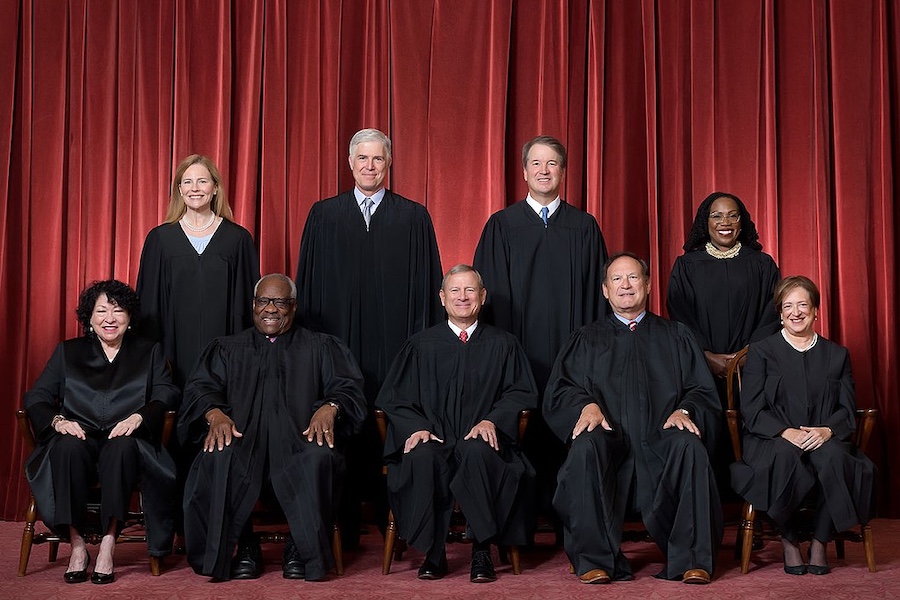
Chief Justice John Roberts joined the Supreme Court’s three liberals in attempting the Trump Administration to block National Institute of Health (NIH) grants that fund left-wing causes like gender reassignment surgeries.
In a 5-4 ruling, the high court on Thursday allowed the Trump Administration to halt nearly $800 million in research grants awarded by the National Institutes of Health that touch on race and gender issues. The ruling was ambiguous, however, as justices declined to bloc ka lower court ruling that tossed guidance from the administration that was used as rationale to cut the funding.
The Supreme Court told grantees that they could still seek funding, though they would need to do so in a different court.
A decision on the grants ultimately broke down 5-4, with Roberts joining the court’s three liberals. All four of these justices said they would have denied the Trump Administration entirely. Four conservatives — Samuel Alito, Brett Kavanaugh, Neil Gorsuch and Clarence Thomas — said they would have sided with Trump entirely.
The case stems from an executive order Trump signed during the early days of his second term in office, which required agencies to terminate grants or contracts that “promote gender ideology” or “immoral race- and sex-based preferences under the guise of so-called” DEI initiatives.
Officials at the NIH terminated more than 1,700 grants in accordance with the guidance.
Democratic officials in 16 states, as well as a number of affected organizations, challenged the grant cancellations. Lower court rulings had sided with the challengers, requiring the administration to allow funding temporarily while the case is litigated further.
Justice Amy Coney Barrett, who wrote a brief concurrence with the other conservative justices, is widely viewed as the key to a final ruling on the case either way it breaks down.
“Four justices would’ve ruled against the administration in full; four would have ruled for it in full; and Barrett split the difference – suggesting that the grant recipients are likely to prevail on their challenges to the Trump administration’s anti-DEI directives, but that they can’t get their grant money until and unless they bring their claims in a different federal court,” said Georgetown Law professor Steve Vladeck. “In other words, Trump won this battle, but the grant recipients seem likely to win the war.”
Justice Ketanji Brown Jackson issued a sharp dissent to the ruling, claiming that the cancellations constitute an “abrupt cancellation of hundreds of millions of dollars allocated to support life-saving biomedical research.”
“This is Calvinball jurisprudence with a twist,” Jackson wrote, referring to the comic strip “Calvin and Hobbes.” “Calvinball has only one rule: There are no fixed rules. We seem to have two: that one, and this administration always wins.”
In her concurrence, Barrett explained that the district court likely lacked the jurisdiction to decide on the individual grants at issue in the case. Instead, Barrett wrote, those suits should have been filed in the Court of Federal Claims.
