
Politics
JUST IN: European, Middle Eastern Leaders Hint At Joining Offensive Operations Against Iran
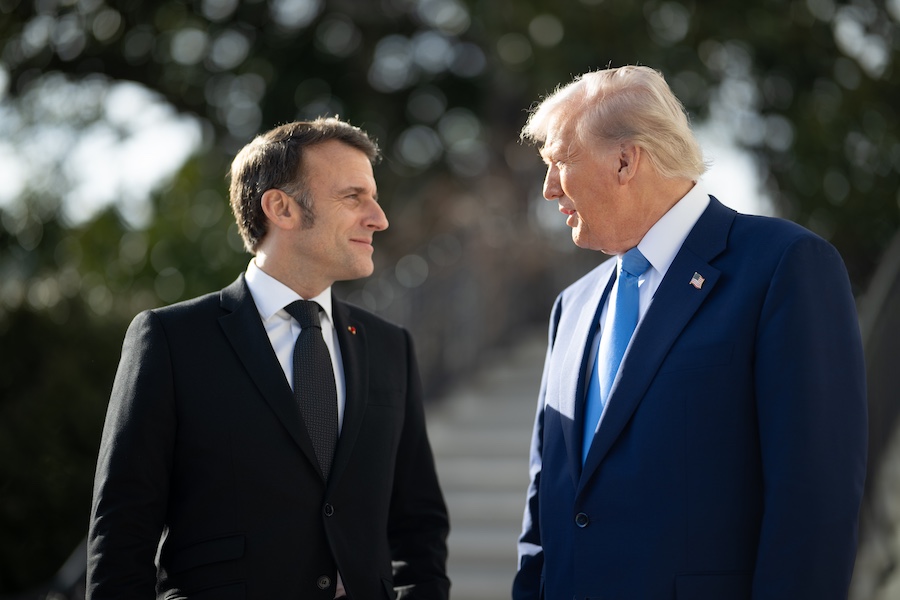
Separate statements from European leaders and the Gulf States indicate that multiple countries may be willing to join a coalition effort against Iranian drone and missile launch sites.
Shortly after Iranian retaliatory attacks commenced against American and Israeli military installations in the Middle East, France, the U.K. and Germany, often referred to as the E3, released a joint statement indicating that they would be willing to participate in defensive measures.
Iran has launched hundreds of drone and missile attacks in the region since the U.S. and Israeli military operation commenced on Saturday morning. The attacks have killed at least three American service members and wounded five others, while more than a dozen civilians in Israel and the United Arab Emirates have been killed. Several additional civilians have been wounded since fighting began.
In addition to impacting American bases, a French hangar at a military installation in the United Arab Emirates was struck by an Iranian drone attack on Sunday morning. The Iranian Revolutionary Guard Corps (IRGC) claimed responsibility for the attack, which did not lead to any casualties.
On Sunday afternoon, the E3 released a new statement in which they expressed openness to joining in offensive operations to degrade Iran’s ability to launch drones and missiles. The statement, which was issued by French President Emmanuel Macron, German Chancellor Friedrich Merz, and British Prime Minister Keir Starmer, stated that the three countries had “consistently urged the Iranian regime to end Iran’s nuclear program, curb its ballistic missile program, refrain from its destabilizing activity in the region and our homelands, and to cease the appalling violence and repression against its own people.”
They added that they were “appalled” by Iran’s “reckless” and “indiscriminate and disproportionate” attacks, which they said endangered military personnel and civilians, including their own service members and citizens in the region.
After again calling on Iran to cease hostilities, the European leaders indicated that they would be willing to engage in offensive operations for the first time. “We will take steps to defend our interests and those of our allies in the region, potentially through enabling necessary and proportionate defensive action to destroy Iran’s capability to fire missiles and drones at their source. We have agreed to work together with the U.S. and allies in the region on this matter,” the statement continued.
The Gulf States — which have been bombarded with Iranian missiles and drones for nearly 48 hours — issued similar statements on Sunday afternoon.
The Gulf Cooperation Council (GCC), comprising Bahrain, Kuwait, Oman, Qatar, Saudi Arabia, and the United Arab Emirates, along with Jordan and Syria, delivered a joint position at a United Nations Security Council emergency meeting. Bahrain’s UN Ambassador Jamal Fares Alrowaei, speaking on their behalf, stated that the attacks were “a blatant violation of our sovereignty and territorial integrity, and they threaten the security and stability of the entire region.”
The statement affirmed that the targeted countries “reserve their right to self-defense under the UN Charter, and to respond proportionally to protect their territories, populations and national interests.”
Saudi Arabia’s Foreign Ministry condemned the strikes “in the strongest terms” as “blatant Iranian aggression” and expressed the kingdom’s “readiness to support any measures” undertaken in response.
Following near continuous strikes by Iran against countries across the Middle East, Foreign Ministers of the Gulf Cooperation Council (GCC); consisting of Bahrain, Kuwait, Oman, Qatar, Saudi Arabia, and the United Arab Emirates, have said that they “reserve the right to respond”… pic.twitter.com/0oAhtHFqqM
— OSINTdefender (@sentdefender) March 1, 2026
As of this report, Iran has launched multiple barrages of missile and drone attacks targeting U.S.and Israeli military installations, and civilian areas, in the region. Impacts and shoot-downs have been recorded in 10 Middle Eastern nations since operations began on Saturday morning.
RELATED: Trump Says Iran’s New Leadership Wants To Talk
