
Politics
JUST IN: Massive SCOTUS Case Could Guarantee House Control For GOP
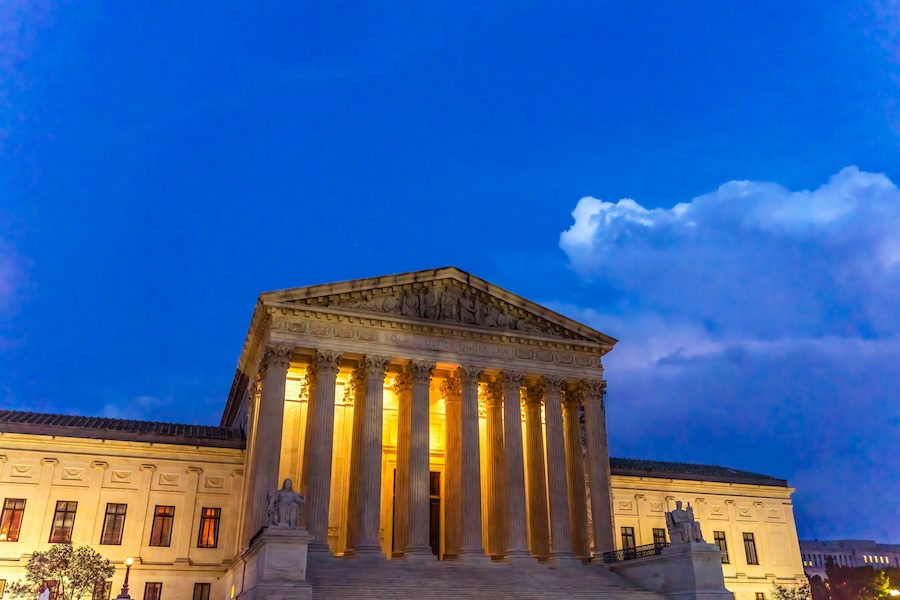
The Supreme Court took a second look at a case that could result in handing the Republican Party guaranteed control of the House of Representatives last week, and initial reports suggest a major ruling is on the horizon. If the highest court in the land strikes down Section 2 of the 1965 Voting Rights Act in Louisiana v. Callais, the GOP’s hold over the House could become insurmountable.
Reports say that if Section 2 is removed, which has been interpreted previously as requiring the creation of majority-minority districts, the Republican Party could toss out a dozen Democratic-held districts in the South.
It all started when a group of voters challenged a 2024 congressional map by claiming that it pushes unconstitutional racial gerrymandering. This means the map sorts voters based on their race, which is a violation of the 14th Amendment.
The court heard two-and-a-half hours of oral arguments, with conservative justices signaling they are most likely going to undermine a key provision of the Voting Rights Act, though they might not strike it down completely.
“Wednesday’s oral argument was the latest chapter in a dispute that dates back to 2022, when Louisiana adopted a new congressional map in the wake of the 2020 census. Roughly one-third of the state’s population is Black, but the 2022 map had only one majority-Black district out of the six districts allotted to the state. That prompted a group of Black voters to go to federal court, where they argued that the 2022 map violated Section 2 of the federal Voting Rights Act, which bars discrimination in voting practices,” SCOTUS Blog reported.
U.S. District Judge Shelly Dick agreed that the 2022 map likely violated Section 2. She then forbade the state from using this particular map in future elections and ordered the state to create a new map featuring two majority-Black districts.
The U.S. Court of Appeals for the 5th Circuit supported that ruling. It then gave the state until January 15, 2024, to produce a new map; otherwise, the lower court would develop a plan for the 2024 elections.
Louisiana then created a new map that created a second majority-Black district. Complaints came forward from a group of voters who referred to themselves as “non-African American.” A three-judge federal district court ruled that the 2024 map violated the Constitution’s equal protection clause, as it sorted voters based on race. The court banned the state from using the map in future elections.
“In May 2024, the Supreme Court put the three-judge district court’s ruling on hold, which allowed the state to move forward with using the new map in the 2024 elections. Voters in the 6th District, the new majority-Black district, elected Cleo Fields, a former member of Congress who had represented another majority-Black district during the 1990s, to represent them,” SCOTUS Blog writes.
Louisiana and the Black voters then appealed to the Supreme Court, which listened to oral arguments for the first time since spring. The state stated that once the lower courts determined the 2022 map likely violated the VRA, it directed the state to redraw a map with a second majority-Black district. State Republicans’ primary goal was to provide protection for the state’s GOP incumbents, such as Speaker Mike Johnson and Rep. Julia Letlow, who is an active member of the House Appropriations Committee.
The “non-African American” voters produced a counterargument saying that it was “utterly implausible” that both race and politics were responsible for the 2024 map. They claimed that the state decided to draw the second majority-Black district and then thought about how to draw a new map that would provide protection for Republicans.
One day before the justices’ summer recess, which began in June, the court issued a brief order setting the case for another argument during the 2025-26 term.
On Aug. 1, the justices issued another order directing litigants to file briefs to address a new question: “whether the State’s intentional creation of a second majority-minority district violates either the 14th or 15th Amendment,” which bans the government from denying or placing restrictions upon someone’s voting rights based on race.
During oral arguments, attorney Janai Nelson, representing the Black voters, presented a defense for the 2024 map. She made the case that “[a] mere two years ago, in Allen versus Milligan, a case nearly identical,” the Supreme Court “noted that under certain circumstances, it has authorized race-based redistricting to remedy state redistricting maps that violate Section 2.”
Louisiana Solicitor General Benjamin Aguinaga urged the justices to “reevaluate its voting precedents.” He then said that those precedents “placed states in impossible situations where the only sure demand is more racial discrimination for more decades.”
He continued, saying, “We have taken the position that Section 2, insofar as it requires race-based redistricting, is unconstitutional.”
Chief Justice John Roberts weighed in, suggesting that the Milligan case shouldn’t dictate the outcome of the case from Louisiana. “That case,” Roberts stated, “took the existing precedent as a given.” He added, “it was a case in which we were considering Alabama’s particular challenge based on … what turned out to be an improper evidentiary showing.”
Experts argue that Section 2 should be repealed due to the 2024 map’s alleged constitutional violation. If this action is taken, Republicans will be all but guaranteed complete control over the House, opening up a pathway that will enable President Trump to complete even more of his agenda over the rest of his term.
Download the FREE Trending Politics App to get the latest news FIRST >>
