
Politics
JUST IN: SCOTUS Asked To Overturn Gay Marriage
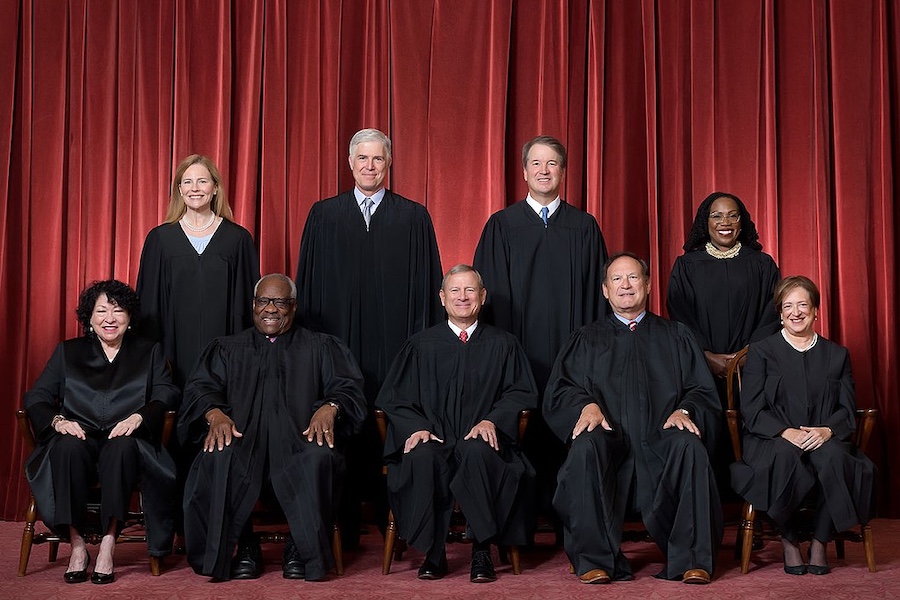
A defendant in the U.S. Supreme Court’s 2015 case legalizing gay marriage has asked the high court to reconsider its decision.
The 2015 Obergefell v. Hodges decision was a landmark moment for gay marriage proponents, who had spent more than a decade toiling in federal court and winning state-level cases before nationwide legalization. The case was brought by former Kentucky clerk Kim Davis, who was jailed for refusing to offer a gay couple a marriage license.
Davis’s attorney, Matthew Staver, said he is optimistic that the Supreme Court will take up the case. William Powell, the attorney who represented the affected couple, said he is equally “confident the Supreme Court will likewise agree that Davis’s arguments do not merit further attention.”
At the beginning of the case, Davis served six days in jail after refusing to provide the marriage license. Her arrest prompted a national outcry from evangelicals who framed the case as an attack on religious liberty.
Davis’s latest case represents the greatest threat to gay marriage since it was legalized just over a decade ago.
Some of the court’s more conservative justices, including Clarence Thomas, have signaled an openness to revisiting the case. The makeup of the court has changed remarkably since 2015, as evidenced by its 2022 decision negating Roe v. Wade.
If the court were to overturn Obergefell, the issue of gay marriage would return to the states, where many do not have explicit laws on the books allowing gay marriage.
In a recent filing, Staver argued that it would be appropriate for the high court to revisit the case.
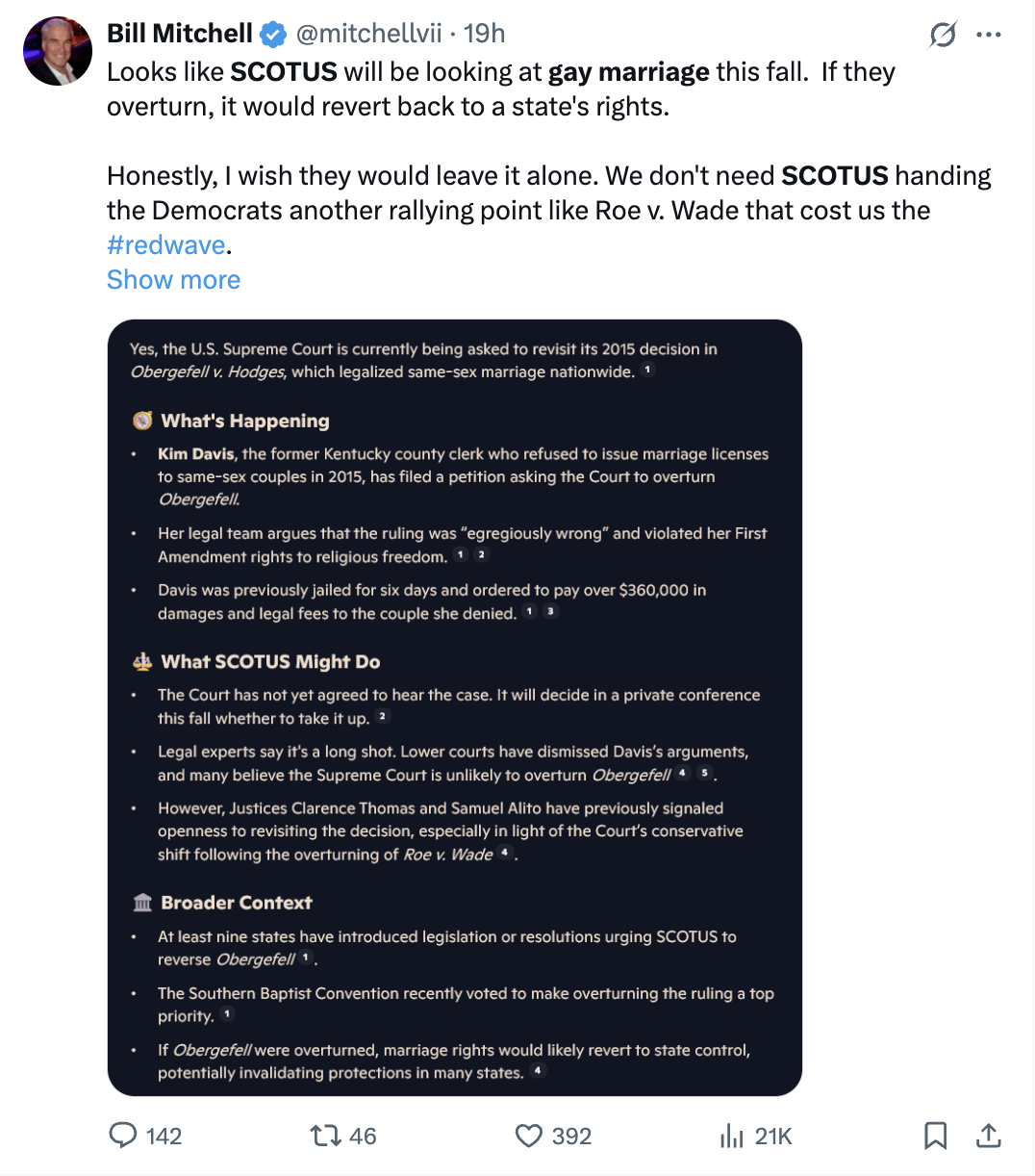
“Obergefell was ‘egregiously wrong,’ ‘deeply damaging,’ ‘far outside the bound of any reasonable interpretation of the various constitutional provisions to which it vaguely pointed,’ and set out ‘on a collision course with the Constitution from the day it was decided,'” he wrote.
Davis’ case “presents the ideal opportunity to revisit substantive due process that ‘lacks any basis in the Constitution,'” the petition reads.
“This flawed opinion has produced disastrous results leaving individuals like Davis ‘find[ing] it increasingly difficult to participate in society without running afoul of Obergefell and its effect on other antidiscrimination laws,'” it reads. “And, until the Court revisits its ‘creation of atextual constitutional rights,’ Obergefell will continue to have ruinous consequences for religious liberty.'”
The filing claims that if Obergefell were overturned, any same-sex marriage that has already occurred would be grandfathered in under the law.
Daniel Urman, law professor at Northeastern University, told Newsweek that he thinks it’s unlikely some of the Supreme Court’s newer conservative justices would move to overturn Obergefell, if they choose to review the decision at all. He pointed to Neil Gorsuch, Amy Coney Barrett, Brett Kavanaugh, and John Roberts as individuals who may appear hesitant to hear Davis’s case, underscoring how the court is not immune to public opinion.
“There’s a chance that a conservative majority could use the case to expand the rights of religious objectors to same-sex marriage,” he said. “But that’s not the same as overturning the right itself, and I don’t see a majority of the Court ready to do that. Culturally, same-sex marriage has become embedded in American life, and it is still popular in public opinion polls.”
