
Politics
JUST IN: Supreme Court Deals Blow To Newsom, Bass In Key Ruling For Trump
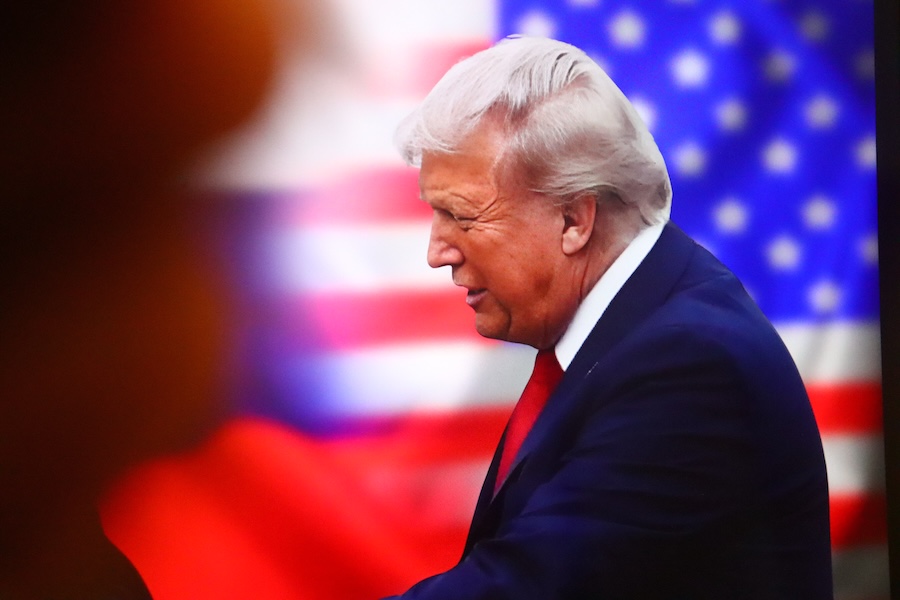
The Supreme Court on Monday cleared the way for federal immigration officers to resume aggressive status checks across the Los Angeles area, granting an emergency stay that halts a district judge’s injunction restricting when agents can make investigative stops. The order is a major setback for California’s political leadership, including Gov. Gavin Newsom (D-CA) and Los Angeles Mayor Karen Bass, who have supported limits on federal operations within the nation’s largest sanctuary jurisdiction. It is a key win for President Donald Trump’s immigration agenda.
In the ruling, the Court granted the government’s application to stay a July 11 order from the U.S. District Court for the Central District of California. The district court had barred officers from making detentive stops based solely on four factors tied to race, language, location, or type of work. The Supreme Court’s administrative ruling keeps those restrictions on hold while the Ninth Circuit appeal proceeds and, if necessary, while the justices consider full review. As the unsigned order states, the district court’s decision is stayed pending the disposition of the appeal in the United States Court of Appeals for the Ninth Circuit and the disposition of a petition for a writ of certiorari, if such a writ is timely sought.
Justice Brett Kavanaugh filed a concurrence laying out why the government cleared the high bar for emergency relief. “I vote to grant the Government’s application for an interim stay pending appeal of the District Court’s injunction,” he wrote.
Citing the Immigration and Nationality Act and long-standing Supreme Court precedent, Kavanaugh noted that immigration officers may “briefly detain” an individual for questioning when they have “a reasonable suspicion, based on specific articulable facts, that the person being questioned . . . is an alien illegally in the United States.”
“The reasonable suspicion inquiry turns on the ‘totality of the particular circumstances,’” he wrote, referencing United States v. Brignoni-Ponce and United States v. Arvizu. He also pointed to the sheer scale of illegal immigration in the region as context for enforcement decisions. According to the concurrence, “About 10 percent of the people in the Los Angeles region are illegally in the United States—meaning about 2 million illegal immigrants out of a total population of 20 million.”
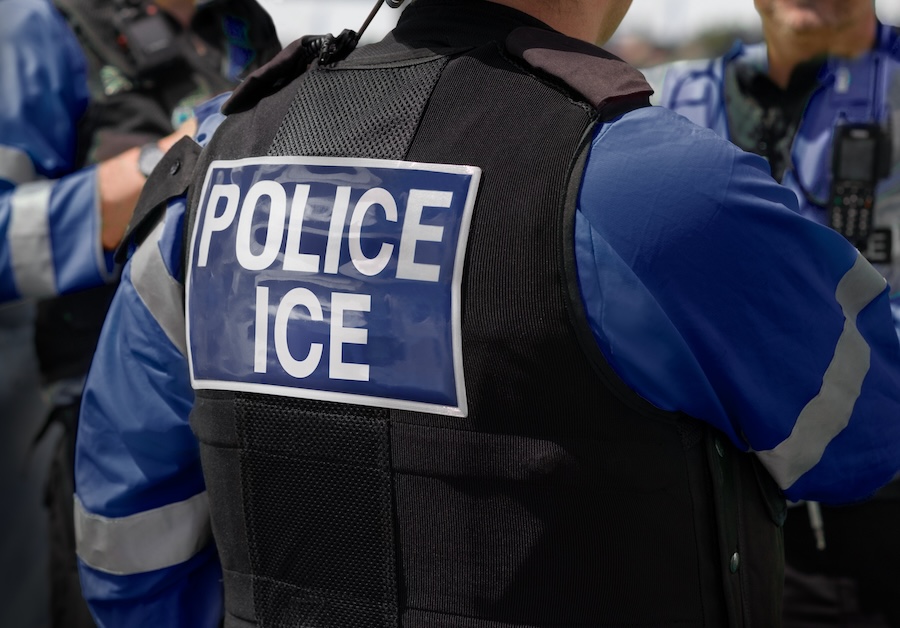
ICE police agent – Officer of Immigration and Customs Enforcement. Close-up of POLICE ICE marking on the back of a stab proof vest uniform worn by a trio of police officers at the scene of an incident
The district court had barred stops based on four factors alone. Kavanaugh said those considerations can be part of the analysis, so long as agents do not rely on race by itself. “To be clear, apparent ethnicity alone cannot furnish reasonable suspicion; under this Court’s case law regarding immigration stops, however, it can be a ‘relevant factor’ when considered along with other salient factors,” he wrote, citing Brignoni-Ponce. He added that the government also showed irreparable harm, quoting a recent case for the principle that whenever the government is enjoined from enforcing statutes, “it suffers a form of irreparable injury.”
The three liberal justices dissented, led by Justice Sonia Sotomayor and joined by Justices Elena Kagan and Ketanji Brown Jackson. Sotomayor described sworn accounts from the record of masked agents arriving at job sites, parks, and transit stops. She warned that the majority’s stay invites broad profiling. “We should not have to live in a country where the Government can seize anyone who looks Latino, speaks Spanish, and appears to work a low wage job,” she wrote.
In her view, the four factors identified by the district court “even when taken together, could not satisfy the Fourth Amendment’s requirement of reasonable suspicion,” and the government had not shown the type of immediate, concrete harm typically required for emergency relief.
The practical effect of the high court’s move is immediate in Southern California. Federal agents can continue brief investigative stops that consider a mix of circumstances tied to location and work settings associated with day labor. If a person proves to be a U.S. citizen or otherwise lawfully present, the concurrence stresses that “they promptly let the individual go.” If unlawfully present, the stop may lead to arrest and removal proceedings.
Monday’s order does not resolve the merits. It signals, however, that a majority of justices view the government as likely to prevail on standing and on the Fourth Amendment question if the Ninth Circuit affirms the injunction. Kavanaugh wrote that to rule otherwise would require “overrul[ing] or significantly narrow[ing]” precedents on both standing and immigration stops.
The stay places Los Angeles back under federal rules that rely on the totality of circumstances, delivering a clear legal and political boost to the White House and a defeat for Newsom and Bass as they navigate the next phase of the fight.
