
Politics
JUST IN: Trump Unveils New Strategy For Iran War
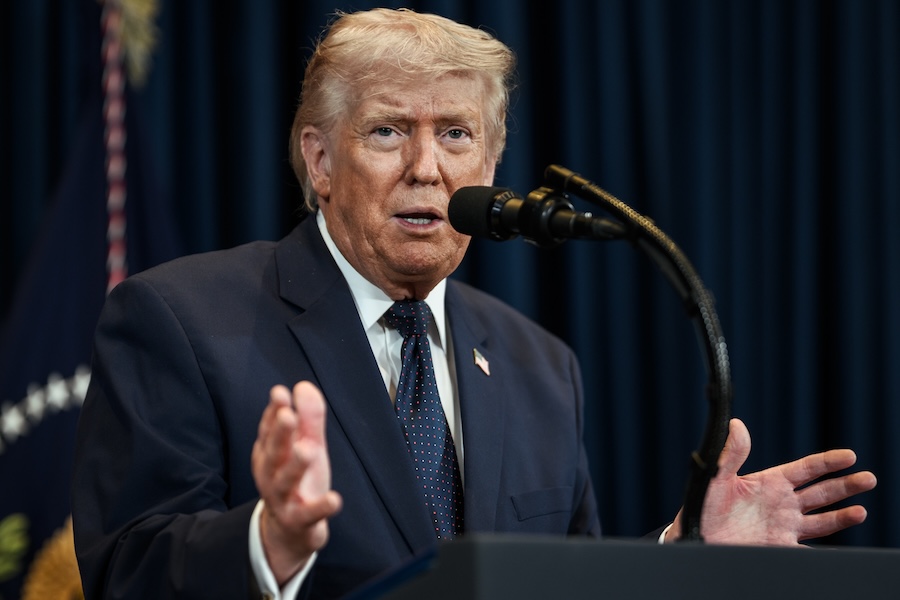
President Donald Trump says the United States is shifting gears in its conflict with Iran, dialing back direct military action while turning up the economic pressure on Tehran.
Trump said Sunday that his administration is taking a more restrained approach for now, watching Iran’s economy buckle under inflation, sanctions and pressure from the U.S. naval blockade.
‘We are low-keying it. We are only semi-negotiating with them,’ he told Axios on Sunday. ‘We are just watching Iran with its huge inflation and the fact they have no money.’
Trump argued that Tehran is already in serious financial trouble and struggling to pay its forces.
‘It will work out. It always works out. It’s like a chess game,’ he added.
The shift comes as Washington and Tehran remain locked in tense talks over the Strait of Hormuz, the critical shipping route that has been largely closed since the conflict began in late February.
A proposed agreement brokered through Oman had appeared close to completion before Iran issued a sweeping list of new demands Saturday.
Under the framework, Iran would have received partial control over traffic through the strait.
President Trump says the U.S. has shifted from military pressure to letting economic strain on Iran build, telling Axios “we are low keying it.” @CorySmithNews
More: https://t.co/e3ckwwUkz6 pic.twitter.com/I6LS86XhjU
— NewsNation (@NewsNation) August 10, 2026
Instead, Tehran’s Supreme National Security Council said the waterway would remain closed until the United States ‘corrects its behavior.’
Iran also suggested that vessels linked to ‘hostile countries’ could be blocked from passing through.
Tehran demanded an end to U.S. threats, a permanent halt to the war involving Iran and its armed allies, an end to the naval blockade of Iranian ports and the withdrawal of American forces from the region.
The regime also called on Washington to ‘completely compensate’ Iran for war damage, lift sanctions and ‘unconditionally’ release frozen assets.
Trump did not publicly accept those demands.
Iranian Foreign Minister Abbas Araghchi also said there were no active negotiations between Washington and Tehran, raising more questions about how close the two sides actually are to a deal.
RELATED: JUST IN: Iran’s ‘Proof Of Life’ Footage Of Mojtaba Khamenei Brutally Backfires
A 60-day negotiating window is set to expire in just over a week, though it could still be extended.
Trump’s new approach appears aimed at letting economic pressure do more of the work while keeping military options in reserve.
The strategy comes as other conflicts across the Middle East remain unsettled.
Israeli Prime Minister Benjamin Netanyahu rejected a Gaza agreement announced by Trump last month, saying Israel would not pull back until Hamas is disarmed.
Netanyahu told his Cabinet that ‘Israel rejects the 15-point document’ while saying discussions with Washington were continuing.
Donald Trump had said Israeli forces would withdraw as Hamas disarmed.
RELATED: JUST IN: Trump Announces Ceasefire Breakthrough
Hamas official Bassem Naim said the group remained committed to the proposal.
‘We remain committed to the road map,’ Bassem Naim, a member of the Hamas political bureau, said.
Meanwhile, Iranian-backed Houthi forces launched another attack on the Yemeni port city of Mocha late Sunday, their second strike on the Red Sea city in less than 24 hours.
A Houthi military source said the attack targeted weapons depots and Saudi troop concentrations.
Yemen’s government-allied forces said ballistic missiles and drones struck residential areas, killing at least seven people and injuring 15 civilians.
Fayed al-Noman, an official in Yemen’s information ministry, said the attack caused heavy damage to port buildings, piers, commercial goods and food supplies.
Mocha is a major port controlled by Yemen’s internationally recognized government and has become increasingly important for shipping trying to avoid the Houthi-controlled port of Hodeida.
For now, Trump appears content to let Tehran stew under economic pressure rather than rush into another round of strikes, betting that Iran’s financial pain will eventually force the regime back to the table.
POLL: Will You Support Trump And His Candidates In The Midterms?
