
Politics
Little Known House Rule Could Stop DSA Candidates From Being Sworn In
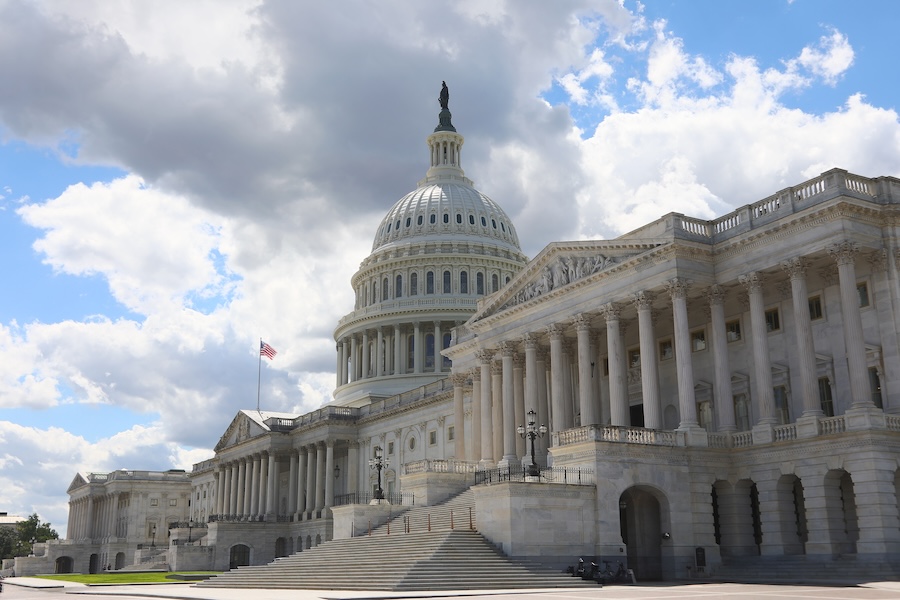
A little-known House procedure is drawing fresh attention from Republicans as lawmakers consider whether incoming members affiliated with the Democratic Socialists of America could be challenged before taking their seats in Congress.
The potential showdown centers on the constitutional oath required of every newly elected House member and a controversial proposal to question whether candidates who support replacing the Constitution can sincerely promise to defend it.
At the center of the dispute is the Democratic Socialists of America’s political platform, which calls for replacing the existing Constitution with a new governing document.
Rep. Keith Self, R-Texas, told Fox News Digital that he is considering challenging incoming socialist lawmakers over their commitment to the nation’s founding charter.
“You cannot swear an oath to support and defend the Constitution while actively working to destroy it. The oath of office is not just words you say at a ceremony. It is a belief. It is an oath to our country and our fellow countrymen,” Self said.
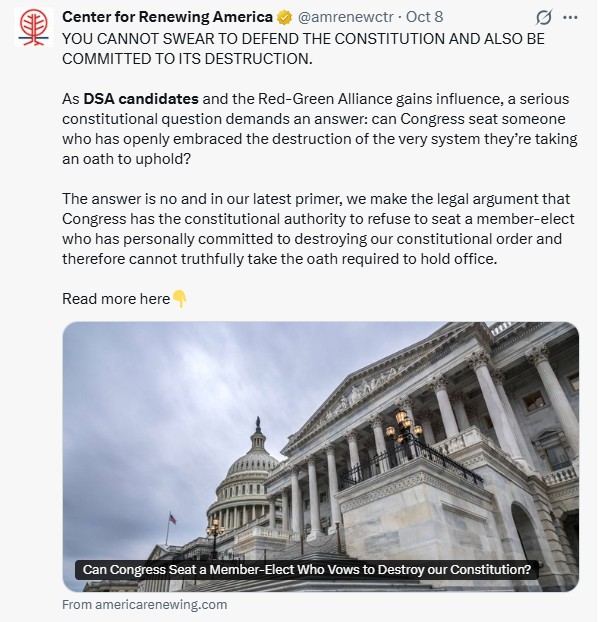
“The House has both the authority and the duty to ensure that anyone who takes that oath does so in good faith, without mental reservation or purpose of evasion. As DSA candidates and the Red-Green Alliance gain ground, we must enforce the Constitution as written or risk allowing people committed to replacing it to take seats of power under false pretenses.”
Screenshot-X
Self argued that the oath should be more than a formality for politicians seeking federal office.
“Anyone who has personally embraced the destruction of the Constitution has no business being sworn in to uphold it,” he said.
Under normal circumstances, newly elected representatives take the oath together at the beginning of a congressional session, with the House speaker overseeing the ceremony.
POLL: Will You Support Trump And His Candidates In The Midterms?
However, an analysis from the conservative Center for Renewing America outlines a procedure through which a member-elect could object to another incoming lawmaker taking the oath.
The objection would involve presenting evidence to the House and requesting consideration of whether the challenged member-elect intended to uphold the Constitution.
“The objecting member should place the documentary record before the House, and the House should debate whether that evidence establishes that the member-elect remains committed to destroying the constitutional order,” the organization argued.
The proposal envisions a House vote on a resolution that “establishes the member-elect’s commitment to destroying the constitutional order.”
Supporters of the strategy argue that lawmakers should examine whether candidates who advocate replacing the Constitution can fulfill their obligations under the oath of office.
But the proposal faces a major legal obstacle.
RELATED: JUST IN: Trump Economy Smashes Expectations In Final Report Before Midterms
In the landmark 1969 decision Powell v. McCormack, the Supreme Court ruled that the House cannot refuse to seat a duly elected candidate who satisfies the Constitution’s requirements for membership.
Those requirements include being at least 25 years old, having been a U.S. citizen for seven years and residing in the state represented.
The ruling followed Congress’ attempt to exclude Democratic Rep. Adam Clayton Powell Jr. after his reelection amid financial controversies.
Consequently, attempting to block an incoming socialist lawmaker based on political beliefs could trigger an immediate constitutional challenge.
House Speaker Mike Johnson, R-La., has already pushed back against suggestions that Republicans intend to disregard election results.
During an appearance in Iowa, Johnson dismissed the possibility of refusing to seat duly elected Democrats as a “nonsense narrative.”
“We are going to follow the law,” he told reporters.
Nevertheless, some Republicans remain interested in testing the procedure.
Rep. Tim Burchett, R-Tenn., previously indicated that he would attempt to block Democratic socialist Darializa Avila Chevalier from taking office.
Chevalier defeated a longtime Democratic incumbent in a heavily Democratic district and has faced criticism over a deleted 2019 social media post in which she described wiping her hands on an American flag because she lacked a napkin.
RELATED: NEW: Democrats Quietly Panicking, Expecting The Polls To Be Wrong Once Again
Burchett cited the incident as grounds for questioning her eligibility to take the congressional oath.
However, criticism of the American flag or support for constitutional reform does not automatically disqualify a candidate from serving in Congress.
The broader dispute comes as several candidates associated with democratic socialism prepare for Tuesday’s elections.
Republicans considering the strategy would also face a practical challenge: The next House speaker would play a significant role in determining how any objection is handled.
If Democrats regain control and elect Rep. Hakeem Jeffries of New York as speaker, the proposal could face immediate opposition.
Johnson could likewise decline to pursue it if Republicans maintain their majority.
For now, no incoming DSA-affiliated lawmaker has been barred from taking office through the proposed procedure.
