
Politics
NEW: Evacuation Area Reduced In California Chemical Tank Crisis
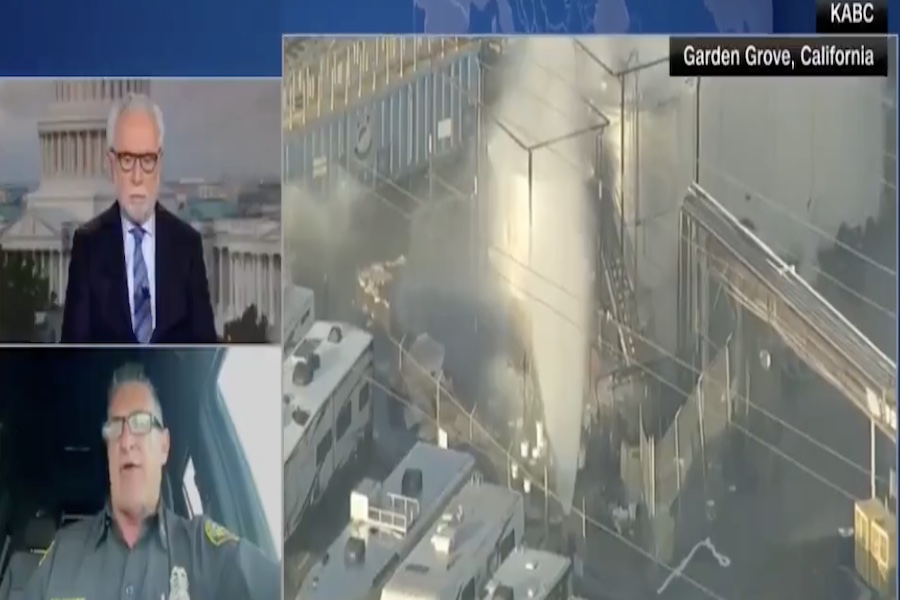
Officials have stated that the worst is over in the chemical tank incident at GKN Aerospace in Garden Grove that affected approximately 50,000 residents across parts of Orange County, California. The overheating tank was previously in danger of exploding, which could have led to one of the worst industrial accidents in recent U.S. history.
On May 21, emergency responders with the Orange County Fire Authority responded to a hazardous materials situation at the GKN Aerospace facility. The response centered on a 34,000-gallon tank holding about 7,000 gallons of methyl methacrylate (MMA), a flammable chemical used in aerospace manufacturing, which overheated due to a refrigeration system valve malfunction.
The tank began venting vapor, bulged, and developed a crack, leading to concerns over a possible spill or boiling liquid expanding vapor explosion (BLEVE). Such a scenario could have caused secondary explosions of nearby tanks.
Mandatory evacuation orders covered a roughly nine-square-mile area, impacting residents in Garden Grove and portions of Anaheim, Buena Park, Cypress, Stanton, and Westminster. A state of emergency was declared, followed by federal support.
Crews applied water for cooling and confirmed overnight on May 24–25 that a crack had relieved pressure. By May 25, officials stated that the risk of a major BLEVE had been eliminated as tank temperatures stabilized and trended downward.
The evacuation zone was soon reduced by about 65 percent, allowing most of the original 50,000 evacuees to return while approximately 16,000 remained under orders in a smaller area, according to a report from CBS Los Angeles.
A BLEVE event could have produced a powerful explosion and fireball, which would have dispersed toxic vapors over a wide area and potentially igniting fires. Modeling for a toxic plume under varying conditions prompted the initial broad evacuation.
A contained spill, while requiring cleanup to avoid local environmental effects, was considered less severe than widespread vapor release.
All evacuation orders were lifted on the evening of May 26 after further monitoring confirmed stable conditions, with no remaining risk of significant leak, fire, or explosion. Officials stated the threat is over, though an exclusion zone remained briefly for final assessments.
Air quality showed no issues, and no widespread contamination was reported. Investigations into the incident, including by the Orange County District Attorney, continue, alongside reviews of facility operations, according to a report from the Los Angeles Times.
The Trending Politics News app is your home for breaking updates. Download it FREE today!
