
Politics
NEW: SAVE America ACT Hits Major Snag
A key Republican-backed election integrity bill hit an unexpected delay in the Senate this week, as lawmakers shifted focus to more immediate priorities, including funding for the Department of Homeland Security.
Sen. Mike Lee (R-UT) confirmed Tuesday that consideration of the SAVE America Act had been postponed following the chamber’s return from a two-week recess, citing unresolved legislative business that must be addressed first.
“We were supposed to be getting back on the Save America Act today after a two-week recess,” Lee wrote in a video posted to X. “And we got back in today, and now we learned that we’ve got to deal with other things first, including DHS funding and some things related to the War Powers Act.”
The delay marks a setback for Republicans who have pushed the bill as a cornerstone of election reform, particularly after it cleared the House earlier this year. The SAVE America Act, short for Safeguard American Voter Eligibility Act, is designed to tighten voter registration and voting requirements nationwide.
Among its central provisions, the bill would require individuals to provide proof of U.S. citizenship—such as a passport or birth certificate—when registering to vote. It would also mandate government-issued photo identification at the ballot box.
WATCH:
In many cases, the legislation would require voters to present documentation in person, even during the registration process. It also calls for states to verify voter rolls using federal databases, including systems maintained by the Department of Homeland Security.
The bill includes additional penalties for election officials who fail to properly verify documentation and could place new restrictions on mail-in and online voter registration systems.
Despite passing the House in February 2026, the bill faces an uphill battle in the Senate, where it is likely to encounter procedural hurdles, including the possibility of a filibuster. Lee suggested that the delay was partly the result of the Senate’s earlier recess, which left several high-priority items unresolved.
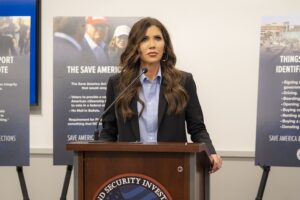
Phoenix, Arizona, 2026 February 13. Secretary of Homeland Security Kristi Noem holds a roundtable with Maricopa County Election Integrity Officials and holds a press conference addressing SAVE (Safeguarding American Voter Eligibility Act)
“This is one of the reasons why I was reluctant to have the Senate take a two-week recess,” Lee said. “When we came back, those other unfinished tasks still have to be finished.”
Among those tasks are negotiations over DHS funding, a recurring flashpoint in Congress, as well as matters tied to the War Powers Act. While the delay is not necessarily fatal to the bill, it underscores the crowded legislative calendar and the difficulty of advancing major reforms in a divided Senate.
Lawmakers have indicated they intend to return to the SAVE America Act once more urgent issues are resolved. However, with political divisions already sharp on voting laws, the timeline for further action remains uncertain.
For now, the bill remains in limbo—caught between competing priorities and a Senate schedule that continues to shift.
