
Politics
NEW: SCOTUS Delivers Major Voter ID Win For GOP Days Before Midterms
The Supreme Court handed Republicans a significant victory in the battle over voter identification Thursday, allowing New Hampshire to enforce restrictions on student IDs just days before the November midterm elections.
Justice Ketanji Brown Jackson was the only justice to publicly dissent as the high court cleared the way for the state to prohibit student identification cards from being used to verify a voter’s identity, including under alternative verification procedures.
The decision delivers a timely win for Republican officials defending New Hampshire’s election rules as competitive congressional races approach the finish line.
At the center of the dispute is a state law signed in April that took effect in June, removing student identification cards from the list of acceptable documents for obtaining a ballot.
New Hampshire Secretary of State David Scanlan subsequently issued guidance clarifying that student IDs could not be used to establish identity, even as supporting documentation through alternative verification methods.
That interpretation prompted a legal challenge, with voting rights advocates arguing that the restrictions unfairly burden younger voters.
A federal district judge blocked part of Scanlan’s guidance, concluding that the secretary of state had gone further than the legislation authorized.
The law explicitly removed student IDs from the list of accepted identification, but the lower court determined that the additional prohibition on using them as supporting evidence exceeded its scope.
Screenshot-X
The Republican National Committee supported the state’s position, setting up another election-related showdown before the nation’s highest court.
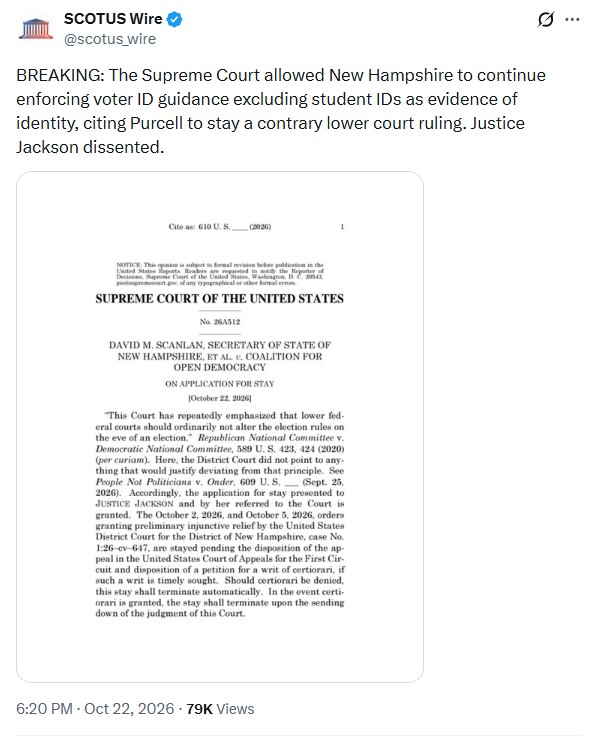
On Thursday, the Supreme Court sided with New Hampshire‘s request to enforce the disputed guidance while litigation continues.
The justices relied on established precedent discouraging federal courts from changing election procedures immediately before voters head to the polls.
The court cited the principle “that lower federal courts should ordinarily not alter the election rules on the eve of an election,” concluding that the lower courts had not adequately justified departing from that approach.
RELATED: VIDEO: Dem Senate Candidate Comes Out Against Voter ID In Pivotal Debate Moment
Ketanji Jackson strongly disagreed, arguing that the approaching election should not prevent courts from correcting what she considered an improper interpretation of state law.
“I respectfully dissent because — even, and perhaps especially, when an election is looming — I would not disturb a clearly justifiable federal-court order issued to ensure that the public receives accurate information about a State’s electoral processes,” she wrote.
Her dissent was the only one publicly recorded, although other justices could have disagreed without identifying themselves in the order.
The ruling comes as voter identification requirements remain a contentious issue between Republicans and Democrats nationwide.
Republicans have emphasized the importance of clear identification standards and consistent election procedures, while Democratic officials and voting rights organizations have argued that certain restrictions can create unnecessary obstacles for eligible voters.
The New Hampshire decision does not prevent college students from voting. Instead, affected voters must provide another form of identification accepted under state election rules.
How many students will be affected remains unclear.
The timing is particularly significant because New Hampshire is home to several competitive races heading into Election Day.
RELATED: Anti-Voter ID Dem Candidate Requires ID To Enter Campaign Events
Fox News currently rates the state’s Senate contest as leaning Democratic, making it a closely watched race as both parties fight for control of Congress.
The governor’s race, meanwhile, is considered likely to favor Republicans.
College students have historically leaned toward Democratic candidates, adding political significance to the legal dispute over identification requirements.
Democrats elsewhere have also pushed to expand the use of student IDs at polling places, including Texas Senate nominee James Talarico.
For Republicans, Thursday’s decision preserves New Hampshire’s existing identification procedures rather than allowing a last-minute court-ordered change.
The Supreme Court‘s action is not a final ruling on the underlying legality of the state’s policy, and the broader case can continue through the lower courts.
POLL: Will You Support Trump And His Candidates In The Midterms?
