
Politics
NEW: USA To Return To The Moon For First Time In 50 Years

In a remarkable acknowledgement of where the U.S. space program is headed, U.S. Transportation Secretary Sean Duffy announced that NASA is preparing to return a manned crew to the surface of the moon for the first time in 50 years.
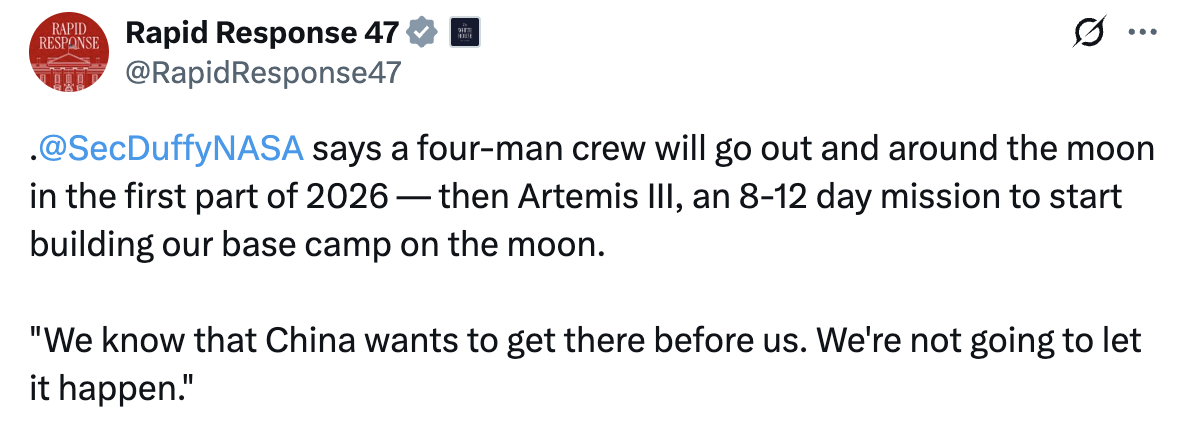
Duffy, who also serves as the Acting Director for NASA, revealed that a four-man crew will be bound for the moon in 2026, when they will undertake a mission to lay the foundations of a U.S. forward operating base. The expedition is expected to last between eight and 12 days.
“The U.S. comes in peace. We want to win the second space race to the moon, but we know that China wants to get there before us,” Duffy explained on Fox News on Wednesday.
Earlier in the day, former NASA Administrator Jim Bridenstine told a U.S. Senate committee that he believes it is “highly unlikely” that the U.S. space program can beat China’s projected timeline and return to the moon first.
NASA’s Artemis program seeks to counter that effort, Duffy responded.
“We’re not gonna let it happen,” he said, adding, “We hope we can do it in the first part of the year.”
“That is gonna be a mission and a four-man crew that’s gonna go out and around the moon. Artemis III is gonna be when we land back on the moon. We’ll stay for a longer period of time, anywhere from eight to 12 days on the moon. The longest time in the past was three days, and again we’re gonna start sending payloads to the moon to start building our base camp.”
The Artemis missions will ostensibly serve as a precursor to manned missions to Mars, Duffy revealed, which he expects to take place in the next decade.
“What we learn on the mission to the moon is gonna be critical to make sure we can sustain life,” he said.
WATCH:
Senate Republicans, such as Ted Cruz (R-TX), have expressed alarm about the possibility of losing the upper hand to China in the race for space dominance. Lawmakers pressed Bridenstine and other space exploration experts on the need for a Gateway space station and continued presence in low-Earth orbit, or LEO.
An immediate risk for the U.S. is the possibility of losing private-sector partners if NASA wavers on its timelines for the Artemis missions. Delays, budget uncertainty, or faltering partnerships between the U.S. and international allies could all drive suppliers into the hands of China, experts told the Senate Commerce Committee.
“The countries that get there first will write the rules of the road for what we can do on the moon,” said Mike Gold, president of civil and international space at Redwire.
