
Politics
NEW: White House Releases Follow-Up Statement On Iran Operation
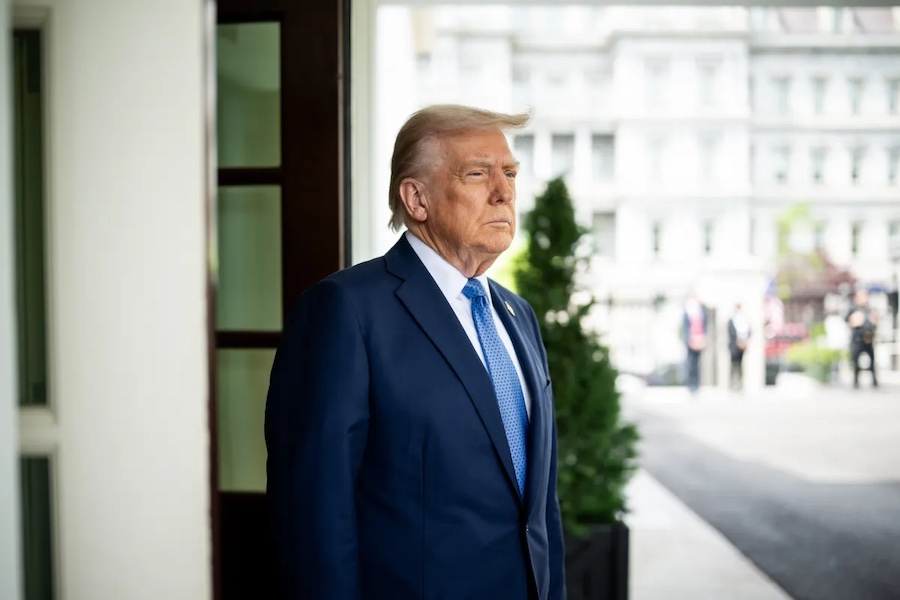
White House Press Secretary Karoline Leavitt issued a new statement after the United States and Israel launched air and missile strikes against Iranian military targets on Saturday morning.
Leavitt explains that President Trump “monitored the situation” from his Mar-A-Lago resort in Palm Beach, Florida as the strikes were ongoing last night and spoke with Israeli Prime Minister Benjamin Netanyahu by phone.
“Prior to the attacks, Secretary Rubio called all members of the gang of eight to provide congressional notification, and he was able to reach and brief seven of the eight members,” the statement continued. “The President and his national security team will continue to closely monitor the situation throughout the day.”
The statement comes after Israel and the United States carried out a joint military campaign against Iran that produced strikes on dozens of high-value targets across the country in what both nations described as a decisive effort to cripple Iran’s nuclear program, ballistic missile arsenal, and senior military leadership.
The operation began in the early morning hours with Israeli Air Force jets conducting the opening wave, followed by additional strikes involving American air and naval assets positioned in the region.
Israeli forces reportedly hit more than 500 individual targets spread across at least 24 of Iran’s 32 provinces. The heaviest concentration of strikes occurred in and around Tehran, where explosions were reported near the Supreme Leader’s compound, the presidential palace, the headquarters of the Supreme National Security Council, and several key military installations.
Other major cities targeted included Isfahan, Qom, Karaj, Kermanshah, and Bushehr. Iranian air defense systems, missile production facilities, underground missile bases, drone storage sites, and command-and-control centers were among the primary objectives.
Preliminary casualty figures released by Iran’s Red Crescent Society indicated at least 201 people killed and 747 injured by late afternoon. Among the confirmed dead were several high-ranking figures, including the secretary of the Supreme National Security Council.
Iranian officials stated that Supreme Leader Ayatollah Ali Khamenei and President Masoud Pezeshkian were alive and accounted for, though communications from senior leadership remained limited.
Iran responded within hours by launching multiple waves of ballistic missiles and drones toward Israel and several U.S. military facilities across the Gulf. Israeli authorities reported air-raid sirens sounding nationwide, with scattered impacts causing fires, structural damage, and 89 injuries, most described as minor. Three missiles reportedly struck Israeli territory directly.
Simultaneously, Iranian and allied forces targeted American bases in Qatar, Kuwait, the United Arab Emirates, and Bahrain. Al Udeid Air Base, Ali Al Salem Air Base, Al Dhafra Air Base, and the U.S. Fifth Fleet headquarters all came under attack during the response.
Collateral damage extended beyond military sites, as drone debris struck civilian areas in Dubai (including the Palm Jumeirah neighborhood and a major hotel), Abu Dhabi, and parts of Syria, killing at least five civilians across those locations. Explosions were also heard in Manama, Kuwait City, Riyadh, and Amman, though most appeared to be intercepted or fell short.
President Donald Trump, in a public address, urged the Iranian people to rise against their government and framed the strikes as part of a broader effort to prevent Iran from acquiring nuclear weapons while degrading its ability to project power.
The operation is expected to last for multiple days, according to a report from Fox News.
