
Politics
Pentagon Rolls Out Doomsday Energy Strategy To Revolutionize American Military Bases
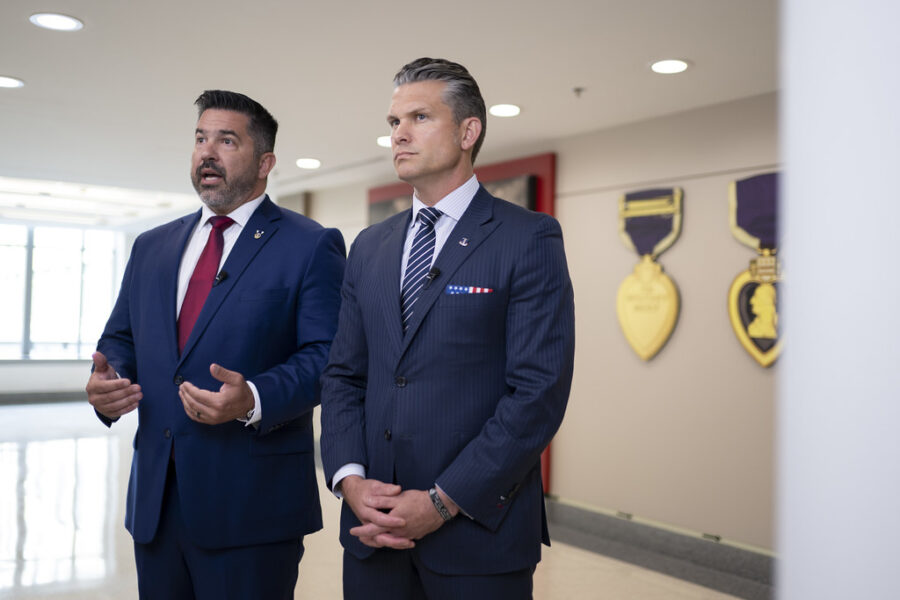
The Pentagon has established the FORTRESS America initiative to enable major military installations in the continental United States to maintain essential operations for at least 90 days without external support.
The program, whose full name is Federal Operations for Resilience, Troop Resources, Energy, Supply, and Survivability, was first announced by Defense Secretary Pete Hegseth on September 30. Officials have characterized it as a national insurance policy for the homeland, intended to reduce long-standing dependence on civilian power grids, overseas supply chains, and single sources of critical materials.
Under the plan, bases must sustain electricity, water, fuel, and communications independently. Mission-critical power is to be independent, hardened, and redundant. Approaches under consideration include portable nuclear reactors, large-scale battery storage, and microgrids capable of isolating installations from the civilian electrical grid.
These measures would allow command centers, aircraft operations, and logistics functions to continue if the commercial grid is disrupted by cyberattack, sabotage, or other means. The effort builds on earlier work, including the Army’s Janus program, which has awarded contracts totaling up to $2.2 billion for microreactors at several installations, with initial deployments targeted in the coming years.
Supply-chain resilience forms another core element of the initiative, Hegseth explained. FORTRESS calls for strategic reserves of munitions, fuel, critical minerals, electronics, spare parts, and medical supplies, including blood. Reserve sizes would be determined by expected wartime consumption rates and production lead times.
The initiative also requires at least two qualified supply or production pathways for critical items to avoid single-point failures. Officials have stated an intent to return key industrial processes — such as those involving rare earths, specialty metals, semiconductors, and propellants — to domestic sources.
POLL: Do You Approve Of Secretary Of War Pete Hegseth?
FORTRESS is strategic deterrence in action, ensuring our defenses are hardened, proactive, and ready.
I created FORTRESS America because we can no longer rely on two oceans to protect us. That outdated assumption no longer reflects the threats we face.
President Trump and…
— Sean Parnell (@SeanParnellASW) October 25, 2026
The Civil Reserve Manufacturing Network is being incorporated to identify commercial factories that could shift to defense production during a crisis. Preparations would include advance technical specifications, cybersecurity measures, contracting arrangements, and conversion procedures, along with recurring industrial stress tests and mobilization exercises.
Additional pillars address installation hardening and cyber resilience, as well as continuity of space-based and electromagnetic capabilities. These include protections for communications, navigation, and satellite systems against jamming or disruption.
The overall framework aligns with broader defense planning that anticipates multi-front conflicts in which global supply chains could be interrupted and adversaries could target U.S. infrastructure more directly than in earlier decades.
Pentagon spokesperson Sean Parnell has noted that reliance on standard civilian municipal infrastructure for national defense constitutes an intolerable risk, observing that without electricity, communications, water, logistics, assembly lines, and basic command structures are affected. He has also indicated that traditional assumptions of protection by two oceans no longer fully apply given current threat environments.
Early emphasis has been placed on energy resilience, with multiyear investment planned rather than a single large appropriation. Details on timelines and total costs for the full set of roughly 500 continental installations remain under development as of this report.
RELATED: Iranian Plots Targeting Americans Have Reached ‘Advanced Stages,’ State Department Memo Warns
