
Politics
Red State Under Fire For Betraying Trump, Backtracking On Redistricting Pledge

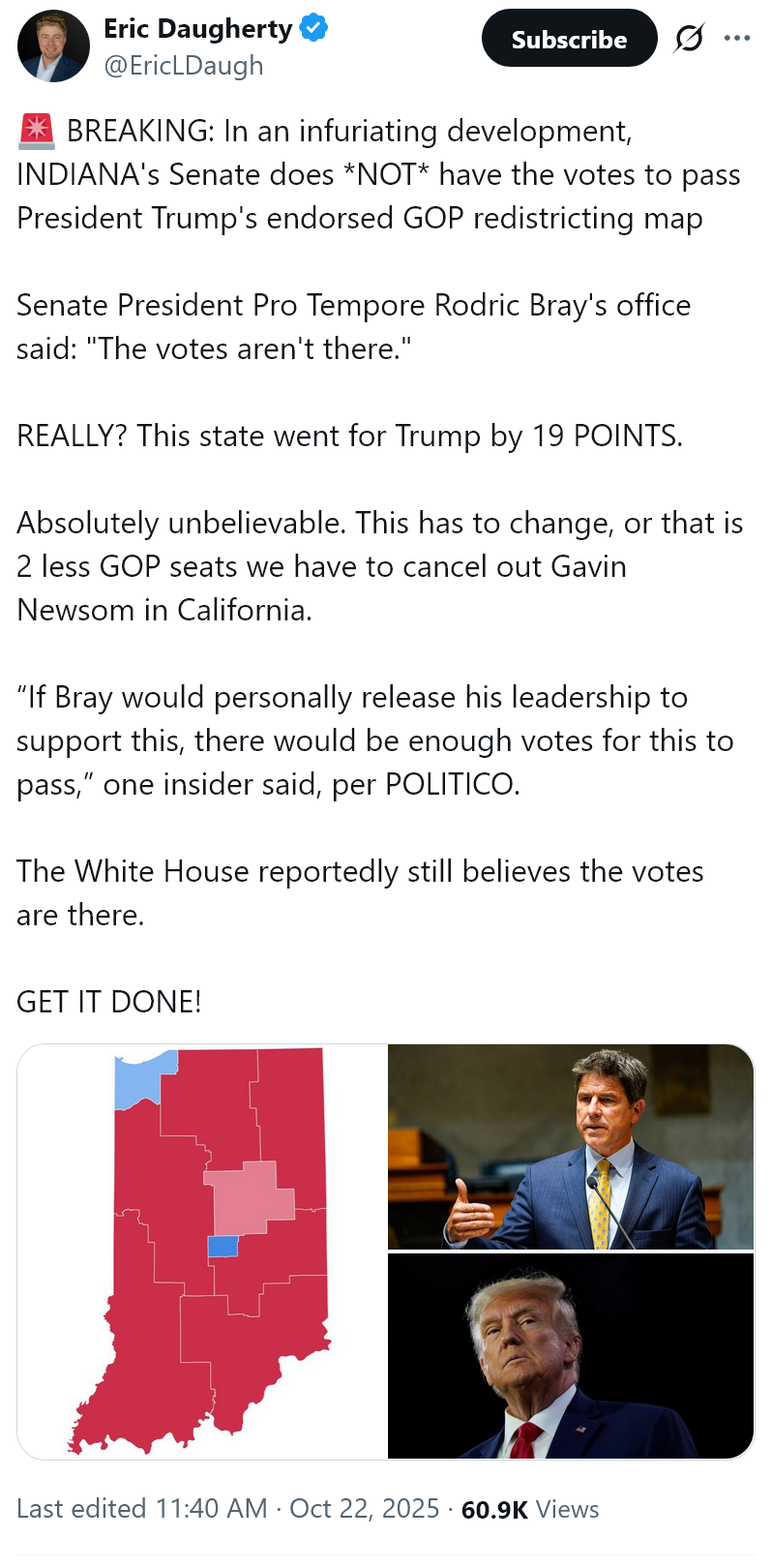
New reports have revealed that Indiana’s Republican-controlled Senate does not have the votes to approve President Donald Trump’s congressional redistricting map, despite the state being carried by 19 points in the 2024 election. This could potentially cost the GOP two seats that were necessary for Republicans to counter Democrat advantages in other places.
Some conservative voices believe Indiana’s inability to secure votes for the redistricting map showcases that there are still splits within the Republican Party at a time when unity has never been more important.
The state’s current congressional delegation stands at 7-2 in favor of the GOP. The proposed redistricting map could flip one or two Democratic-held districts, which both Trump and many of his allies believe to be a critical component of offsetting Democratic gains elsewhere, such as California, currently under the leadership of Gov. Gavin Newsom.
Despite this news, the White House remains optimistic, according to a report from Politico, that the votes can be secured, but the big holdout, seemingly gumming up the works, is Senate President Pro Tempore Rodric Bray.
An insider is quoted as saying that Bray’s personal support could be what tips the scales in favor of the redistricting map, but his office continues to insist the votes aren’t there.
Mid-decade redistricting has become a national battleground, as states such as Missouri and North Carolina have already redrawn maps that provide a boost for the Republican Party’s seat count. In North Carolina, for example, lawmakers approved an additional GOP seat in response to the president’s call to protect the narrow Republican lead in the House.
Another problem redistricting faces is the current Indiana state law. Indiana places limits on redistricting to post-census sessions. However, with a supermajority of Republicans in control, it’s possible to change the limitations. Democratic Rep. Frank Mrvan has promised to fight back against “gerrymandering,” citing the 2010 Fair Districts Amendments, which were crafted to prevent diluting minority voting power. This concern is also shared by other voting rights advocates.
Conservatives, on the other hand, believe the massive 19-point victory Trump won in Indiana justifies an aggressive new map-drawing to fight back against decades of Democratic Party gerrymandering.
Others in the MAGA movement say this isn’t merely a fight over policy, but a litmus test for loyalty to the president’s America First agenda. If this redistricting effort fails, they say, it could result in the loss of two seats and give Democrats leverage to block Trump’s legislative goals in 2026.
