
Politics
Scientists Warn The Earth Could Be Headed For A New Ice Age
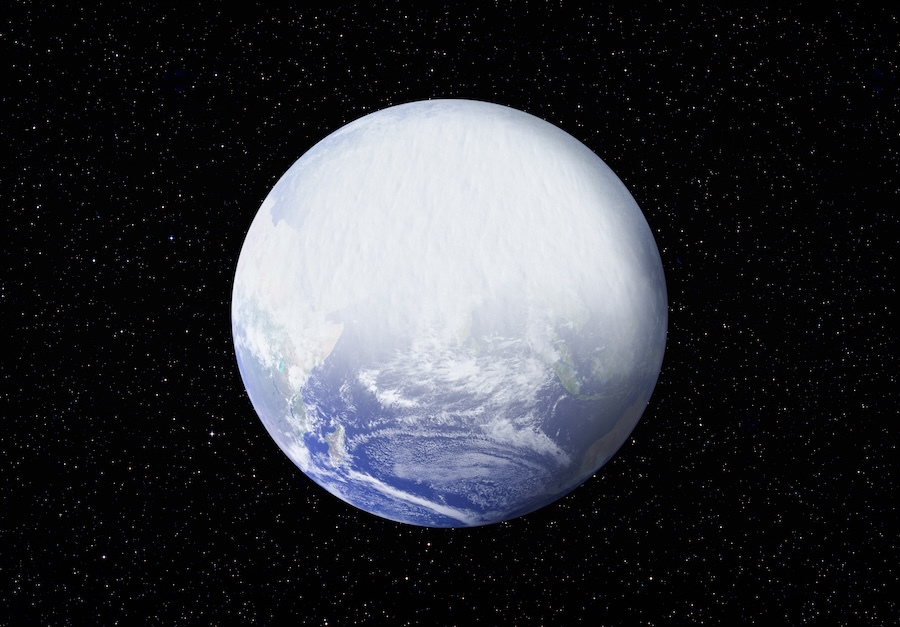
A new study published in Science suggests that global warming could, paradoxically, push Earth toward a future ice age—not by cooling the planet directly, but by triggering a powerful chain reaction deep within the oceans.
Researchers Dominik Hülse and Andy Ridgwell developed a next-generation Earth system model to test how the planet’s long-term climate “thermostats” respond to massive amounts of atmospheric carbon dioxide. Their findings point to an unexpected possibility: if warming becomes extreme enough, it may activate faster-moving chemical and biological feedback loops that drive runaway cooling, potentially locking the planet into an ice age.
For decades, scientists believed Earth’s primary climate stabilizer was the slow weathering of silicate rocks. As temperatures rise, weathering naturally removes more CO₂ from the atmosphere, restoring balance over hundreds of thousands of years. But the new study reveals that a second thermostat—organic carbon burial in the ocean—can overpower that system entirely.
According to the model at Science, a large pulse of CO₂ initially heats the planet, increasing rainfall, erosion, and the delivery of phosphorus from land into the oceans. That nutrient influx supercharges marine life, boosting biological productivity across the globe. As more life grows, more organic matter sinks to the seafloor and decomposes, steadily stripping oxygen from the deep ocean.

via Science
Once oxygen levels fall far enough, the seafloor begins releasing stored phosphorus back into the water, a process that accelerates productivity even further. That sets off a powerful self-reinforcing loop: more nutrients, more growth, more carbon buried in sediments—and a rapidly falling level of atmospheric CO₂.
In the study’s simulations, CO₂ eventually drops far below its starting level. The initial warming flips into an accelerating global chill. Depending on oxygen levels, Earth’s average temperature could plunge by more than 6 degrees Celsius, a shift larger than the difference between today’s climate and the last ice age.
“Overcooling is most strongly expressed at intermediate oxygenation states of the ocean and atmosphere in our model and provides a causal link between major transitions in oxygenation during the Precambrian and the occurrence of extreme cooling snowball Earth events,” the authors wrote, noting that similar feedbacks may have contributed to planet-wide glaciations hundreds of millions of years ago.
The results also highlight an ironic twist: microbial life—the same force that helped shape Earth’s atmosphere—could also destabilize it. By outcompeting the slower rock-weathering feedback, biological activity can pull the planet past its breaking point, tipping it into prolonged cooling.
If multiple climate regulators can collide and overwhelm one another, planetary stability may be more fragile than scientists once thought.
And while the study focuses on geological timescales far beyond the span of human influence, its central message is clear: climate systems can behave in unexpected, non-linear ways. Under the right conditions, extreme warming may sow the seeds of its own icy collapse—showing that the Earth’s future could be far stranger than the simple notion of a steadily warming world.
