
Politics
US Government Admits Role In Deadly DC Helicopter Plane Collision
The U.S. government has formally acknowledged responsibility for a fatal midair collision near Washington, D.C. earlier this year, conceding that failures by both federal air traffic control and an Army helicopter crew contributed to the crash that killed 67 people.
The admission came in a court filing responding to a wrongful death lawsuit brought by the family of one of the victims. In the filing, Justice Department attorneys stated that federal agencies breached their duty of care, citing mistakes made by an FAA air traffic controller as well as errors by the crew of an Army Black Hawk helicopter.
The January collision occurred near Ronald Reagan Washington National Airport as an American Airlines regional jet was on approach. The aircraft struck the Army helicopter in one of the nation’s most tightly controlled and congested airspaces. All passengers and crew aboard both aircraft were killed, marking one of the deadliest aviation disasters in decades.
Robert Clifford, an attorney for the family of victim Casey Crafton, said the government acknowledged “the Army’s responsibility for the needless loss of life” and the FAA’s failure to follow air traffic control procedures, while also “rightfully” recognizing that other parties, including American Airlines and PSA Airlines, contributed to the deaths.
According to investigators, the helicopter was flying higher than authorized at the time of the collision, exceeding its approved altitude by roughly 78 feet. Federal filings also pointed to failures in situational awareness and communication, including the air traffic controller’s inability to adequately warn the commercial jet of the approaching military aircraft.

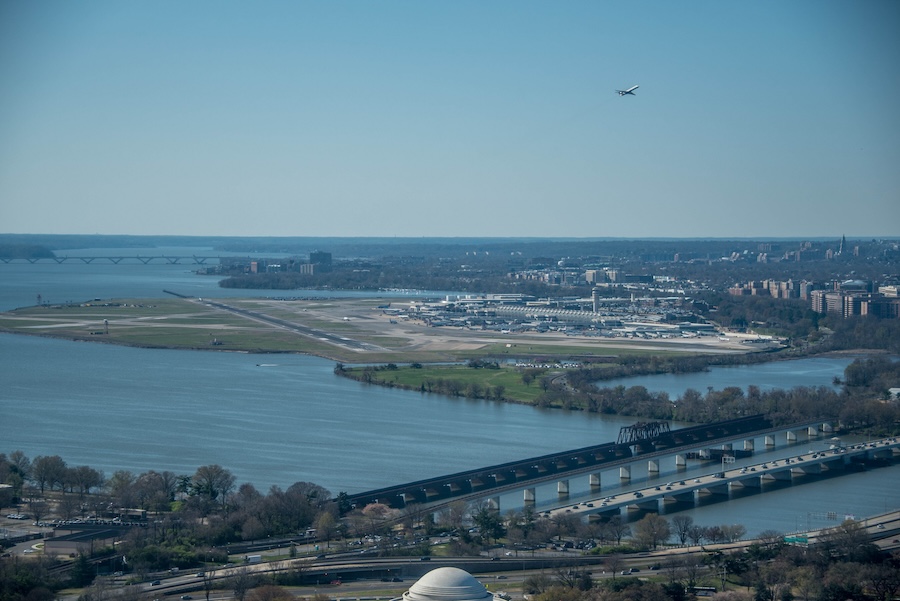
Washington DC, USA – 1 May 2024: Passenger plane landing at Ronald Reagona National Airport on the banks of the Potomac River in Washington DC.
Further complicating the situation were equipment and operational issues aboard the helicopter. Investigators identified problems involving faulty altitude readings and noted that the Army crew was operating with night vision goggles, which can reduce depth perception and make visual scanning more difficult in crowded airspace.
Families of the victims have long argued the crash was preventable and exposed deeper safety failures around Washington’s airspace. Court filings indicated that federal agencies were aware of prior close calls in the same area but did not take sufficient corrective action before the fatal collision occurred.
While the government stopped short of accepting sole blame, the acknowledgment of negligence is significant. It places primary responsibility on federal agencies rather than the airline involved. American Airlines and its regional subsidiary have both sought to be dismissed from the lawsuit, arguing that the collision resulted from government-controlled airspace operations rather than airline error.
The admission has already prompted operational changes. Following the crash, the FAA imposed new restrictions on helicopter flights near Reagan National and barred certain Army helicopter operations around the Pentagon. The Army also conducted inspections and recalibration of aircraft altimeters and updated maintenance and safety protocols.
Lawmakers moved quickly in response as well. The U.S. Senate passed legislation aimed at tightening safety requirements for military helicopter operations in congested civilian airspace. The bill includes measures focused on improved tracking, coordination, and altitude compliance, and now awaits consideration in the House.
Despite the legal filing, the investigation into the crash is not complete. The National Transportation Safety Board continues to examine the collision and is expected to issue a final report next year. That report will determine the official probable cause and may include additional safety recommendations.
