
Politics
WARNING: China Could Target U.S. Homeland If Iran Conflict Explodes
As tensions between the United States and Iran approach a critical breaking point, a new warning is raising concerns that the conflict could expand far beyond the Middle East — potentially reaching American soil.
On Monday, Foreign policy expert Gordon Chang pointed to a series of unusual drone incursions over U.S. military bases as a possible signal from China. He suggested the activity may not be random, but instead a calculated warning tied to Washington’s growing involvement in the Iran standoff.
Chang said that over the past month, unidentified drones were spotted flying over at least four major U.S. military installations. According to him, the aircraft were large, highly advanced, and resistant to standard countermeasures, making it unlikely they were hobbyist or commercial drones.
“The important point here is that we have had, last month, over four of our important military bases, foreign drones. These drones were large, they were un-hackable, they obviously were not recreational, so some foreign power — probably China, maybe Russia — was operating drones over our critical air force bases,” Chang explained on “Mornings with Maria.”
“Right now, the United States needs to be able to defend its bases in the homeland because those drone flights were a warning to the United States of some sort,” he explained.
The timing of these incursions comes as President Trump intensifies pressure on Iran to agree to a deal or face severe consequences. Speaking at the White House Easter Egg Roll, Trump confirmed that Iranian negotiators had made what he described as a “significant proposal,” but stressed that it still falls short of U.S. demands.
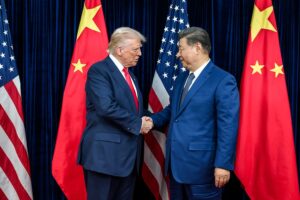
Busan, South Korea – October 30, 2025: Chinese President Xi Jinping is greeted by Chief of Protocol Monica Crowley upon arrival for a bilateral meeting with President Donald Trump at the Gimhae International Airport terminal
“They made a proposal, and it’s a significant step,” Trump said. “It’s not good enough.”
The administration has given Iran until Tuesday night to meet its conditions, part of a strategy combining diplomatic pressure with increased military positioning. The U.S. has responded by increasing its air and naval presence in the region, while Israel has carried out targeted strikes on Iranian-linked military figures.
Against the backdrop, Chang warned that China may be preparing to respond if the conflict intensifies. He argued that the drone activity over U.S. bases — along with a suspicious device recently discovered near MacDill Air Force Base in Florida — could be part of a broader effort to demonstrate capability and send a strategic signal.
“We’ve really got to be concerned,” Chang added saying, “These are warnings that China intends to move on the U.S. in the American homeland.”
Chang also added that China’s growing relationship with Russia and Iran should not be viewed in isolation. Instead, he described an emerging alignment among U.S. adversaries that could complicate any American response.
“China is supporting Russia in Ukraine, and China is supporting Russia in other matters as well,” he said. “They have a durable partnership, and anything that helps one of them is generally going to help the other.”
“Generally speaking, the United States now faces a very powerful combination, and we shouldn’t be doing anything that fuels that combination,” Chang said.
That dynamic, he argued, creates a scenario where escalation in one region could quickly trigger responses elsewhere, including actions aimed directly at the United States.
For now, diplomatic channels between Washington and Tehran remain open, but fragile. Previous ceasefire efforts have stalled, and while Iran’s latest proposal shows some movement, it has not yet met U.S. expectations.
The next 24 hours could prove decisive. If Iran fails to meet the deadline, Trump has warned of “severe consequences,” raising the possibility of further military action.
