
Politics
WATCH: CNN Analyst Lays Out Bleak Midterms Outlook For Democrats
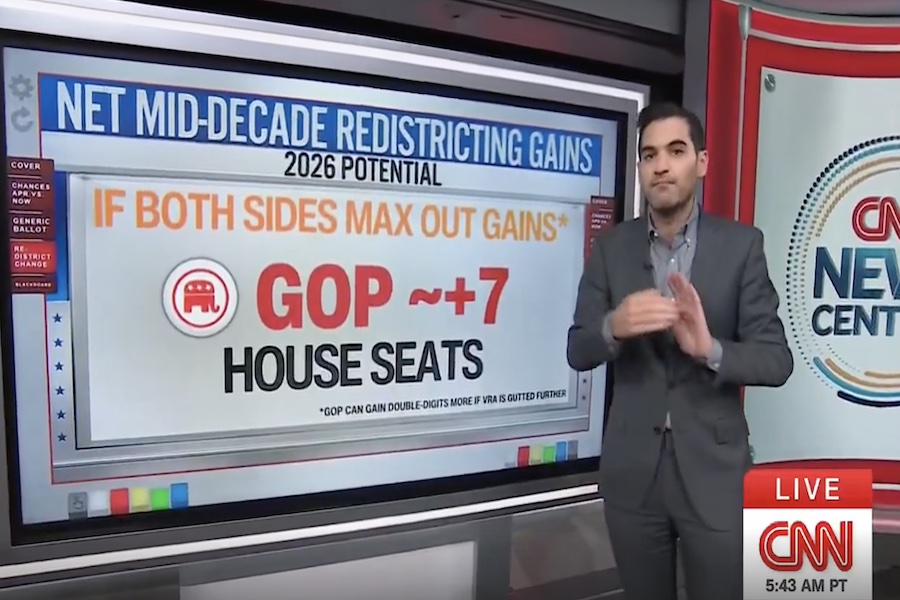
Harry Enten, CNN’s lead polling and data analyst, laid out a grim 2026 midterm elections outlook for the Democratic Party due to lagging approval ratings, a lackluster polling advantage when compared with historical trends and redistricting efforts in Republican-controlled states.
While Democrats are hoping to replicate a 2018 result, commonly referred to as the “Blue Wave” year in which the party saw massive gains in the House and Senate, Enten noted that current data is painting a different picture.
In April 2017, Democrats held a three-point edge in CNN’s generic congressional ballot, the same margin the party held in April of this year. But by October 2017, the party’s edge had expanded to eight percentage points.
As of this October, the Democratic Party’s generic ballot advantage has not moved since April.
“I remember covering this. I remember a lot of folks, including myself, saying, you know what, Republicans look pretty decent right now in terms of the fact that they had the House, they had the Senate, they had the presidency, but things were likely going to flip,” Enten recalled of the polling data in April 2017.
“And I was looking for the same signs this year. The bottom line is, it hasn’t happened. Well, when it hasn’t happened, Democrats have stayed basically steady. They have fallen off the pace. Democrats were way out ahead back in 2017 on the generic congressional ballot. And now we’re basically looking at Democrats ahead,” he continued. “But again, they are so far in back of the pace that they set back there. And so I think what a lot of folks are seeing, folks like myself are saying, wait a minute, given what we might be seeing in redistricting, is this plus three going to be enough?”
Host Kate Baldwin then asked about redistricting efforts in Republican-controlled states and whether it has the potential to further hurt Democrats’ chances.
Enten responded by noting that Republicans have far more room to pick up seats in red states, as Democrat-controlled states such as Maryland and Illinois are already heavily gerrymandered, while other blue strongholds like Massachusetts already have zero Republican-controlled districts.
“If both sides max out at this point, there are more Republican gains possible than Democratic gains. Yes, the Democrats might try to counter a Texas and a California, but you go along in the different states, and basically, Democrats run out of room where Republicans are able to gain and gain and gain,” Enten explained.
“If both sides max out, we’re probably looking at a GOP gain of plus seven House seats. That doesn’t even take into account the potential gutting of the VRA that is right now going to be in front of us.”
The Supreme Court is currently hearing arguments in a monumental case on the Voting Rights Act of 1965, which could lead to the axing of several districts currently drawn along racial lines. This could lead to additional Republican pickups, particularly in the South.
“If you add that in, then you could be looking about adding 10, 12, 15, 17 on top of this seven seats. So I think a lot of folks like myself are looking at this, we’re seeing, ‘hey, wait a minute. Those national polls, Democrats are not getting the way that we expected,'” Enten said.
The midterm elections cycle is heating up! Download the Trending Politics News App to stay in the loop
