
Politics
WATCH: Historic Artemis II Lunar Mission Successfully Launches
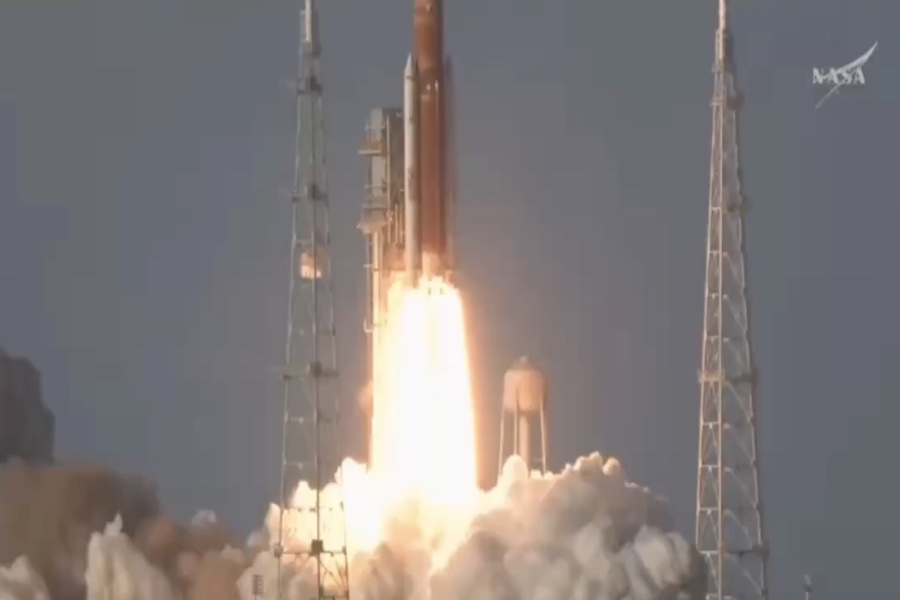
The historic Artemis II moon mission successfully launched from NASA’s Kennedy Space Center in Florida in the evening hours of Wednesday, April 1, 2026. The historic mission marks the first human mission beyond low Earth orbit since Appollo 17 in 1972.
The SLS rocket, standing approximately 322 feet tall, provided more than 8.8 million pounds of thrust at liftoff.
The two-hour launch window opened at 6:24 p.m. Eastern Time, which proceeded without delay. The international crew could be seen making their way to the launch pad while large crowds gathered in Cape Canaveral to view the historic liftoff.
Around 6:30 p.m. Eastern Time, the rocket officially without issue. “Bound for the moon, humanity’s next great voyage begins,” one NASA official said as liftoff occurred.
Artemis II is the second flight in NASA’s Artemis program and the first crewed mission to use the Space Launch System (SLS) rocket and Orion spacecraft. The flight sends four astronauts on a lunar flyby trajectory to test spacecraft systems in deep space ahead of future lunar landings.
Unlike later Artemis missions that will include surface landings, Artemis II focuses on verifying the Orion vehicle’s performance with a crew aboard, including life-support systems, navigation, and reentry capabilities. The mission builds directly on the uncrewed Artemis I test flight conducted in 2022.
The crew consists of NASA astronauts Commander Reid Wiseman, Pilot Victor Glover, and Mission Specialist Christina Koch, along with Canadian Space Agency Mission Specialist Jeremy Hansen. The astronauts will conduct systems checks, monitor spacecraft performance, and perform a proximity operations demonstration using the spent Interim Cryogenic Propulsion Stage as a target, without making physical contact.
Once in orbit, the crew will perform multiple checkout procedures on Orion’s environmental control and life-support systems, communications, and navigation equipment. After roughly one to two days in Earth orbit, the Interim Cryogenic Propulsion Stage will execute the trans-lunar injection burn to send Orion on a free-return trajectory around the Moon, according to NASA’s mission summary.
The spacecraft will reach its closest approach to the Moon approximately four to five days after launch, passing behind the far side of the Moon before beginning the return leg. At its farthest point from Earth, the mission will set a new record for human distance traveled from the planet.
The return trajectory uses the Moon’s gravity to slingshot Orion back toward Earth without additional major propulsion burns after the initial injection.
The full mission lasts approximately 10 days. Splashdown is planned for April 10, 2026, in the Pacific Ocean off the coast of California. During the final phase, Orion’s service module will separate from the crew module, which will reenter Earth’s atmosphere at speeds approaching 25,000 mph and slow via parachutes before landing in the ocean for recovery by NASA teams.
Throughout the flight, the crew will evaluate Orion’s ability to support humans during extended deep-space operations, including cabin pressure, temperature control, radiation monitoring, and crew comfort. Data collected will inform design refinements for subsequent Artemis missions, which aim to land astronauts on the Moon by the late 2020s and support longer-term exploration goals.
RELATED: Astronaut Shares Chilling Pic Of ‘Tentacled Object’ Growing On Side Of Space Station
