
Politics
WATCH: Pentagon Releases Footage Of Strike On Massive Iranian Drone Carrier
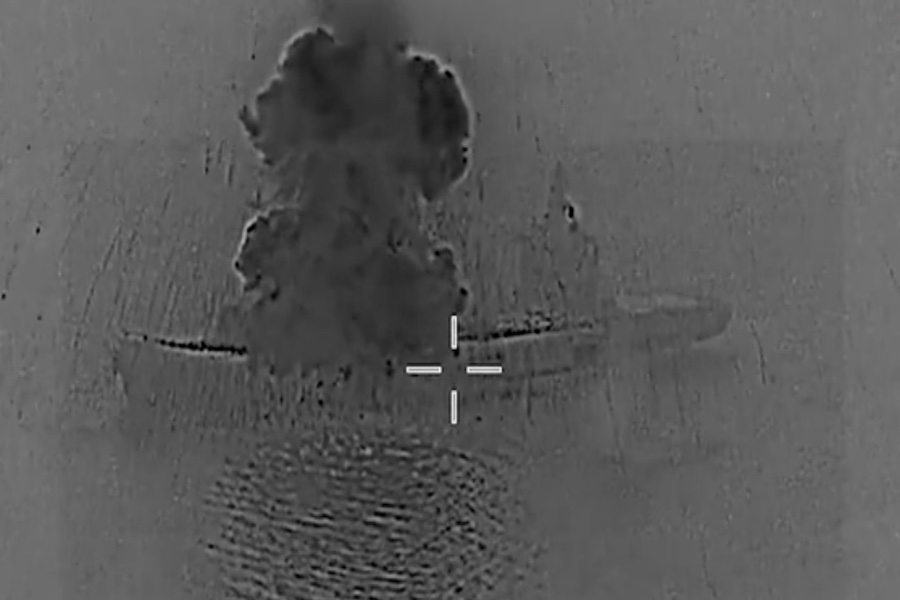
U.S. Central Command (CENTCOM) has released harrowing footage of a strike on a massive Iranian drone-launching vessel, which Pentagon officials have described as the size of a World War II-era aircraft carrier. The latest sinking comes as part of more than 3,000 strikes launched against Iranian targets by U.S. and Israeli forces since hostilities erupted on February 28.
CENTCOM released video footage of two strikes that impacted the ship’s port side on March 5, which resulted in visible fires. CENTCOM Commander Admiral Brad Cooper confirmed during a press briefing that the ship was on fire following the attack.
“U.S. forces aren’t holding back on the mission to sink the entire Iranian Navy. Today, an Iranian drone carrier, roughly the size of a WWII aircraft carrier, was struck and is now on fire,” CENTCOM posted on social media alongside footage of the strikes.
Both Cooper and War Secretary Pete Hegseth confirmed that the vessel — which was the size of a WW2-era aircraft carrier — was used to launch Shahed class one-way drones that have been used extensively in Iranian counterattacks on U.S. and allied forces in the region.
The action is part of a broader effort that has destroyed over 30 Iranian vessels since the operation began.
President Donald Trump has indicated that Operation Epic Fury, the U.S. Military’s codename for operations in Iran, is aimed at eliminating Iran’s nuclear weapons program in its entirety, degrading missile capabilities and affecting regime change if possible.
The campaign has involved strikes on more than 3,000 Iranian positions, including command centers, air defenses, missile sites, and military airfields. U.S. forces have targeted over 1,700 sites, with B-2 stealth bombers deploying dozens of 2,000-pound penetrator bombs on buried missile launchers, the Pentagon said in its most recent update.
During a March 5 press conference at CENTCOM headquarters in Tampa, Florida, Secretary Hegseth and Admiral Cooper provided extensive battle damage assessments.
Cooper stated that Iranian ballistic missile attacks have decreased by 90 percent and drone attacks by 83 percent since the operation’s start. “In just the last 72 hours, America’s bomber force has struck nearly 200 targets deep inside of Iran, including around Tehran. And in just the last hour, U.S. B-2 bombers dropped dozens of 2,000 pound penetrator bombs targeting deeply buried ballistic missile launchers.”
Hegseth refused to commit to an exact timetable for the operation, but indicated that it could last for several weeks. “You can say four weeks, but it could be six, it could be eight, it could be three… Ultimately, we set the pace and the tempo,” he said/
Iranian counter-attacks have included missile and drone barrages on U.S. bases in Kuwait, Bahrain, and Iraq, as well as strikes on Israeli territory and Saudi oil infrastructure like the Ras Tanura refinery. Officials have confirmed that six U.S. service members were killed in a March 1 strike on a U.S. Military installation in Kuwait, with a dignified transfer slated for Saturday, March 7.
In addition, 11 Israeli civilians and nine additional civilians across the Gulf States have been killed as a result of Iranian attacks.
Get breaking news FIRST with the Trending Politics News app. Download it free today!
