
Politics
WATCH: Trump Smacks Down Reporter’s ‘Gotcha’ Question With Brutal Clap Back
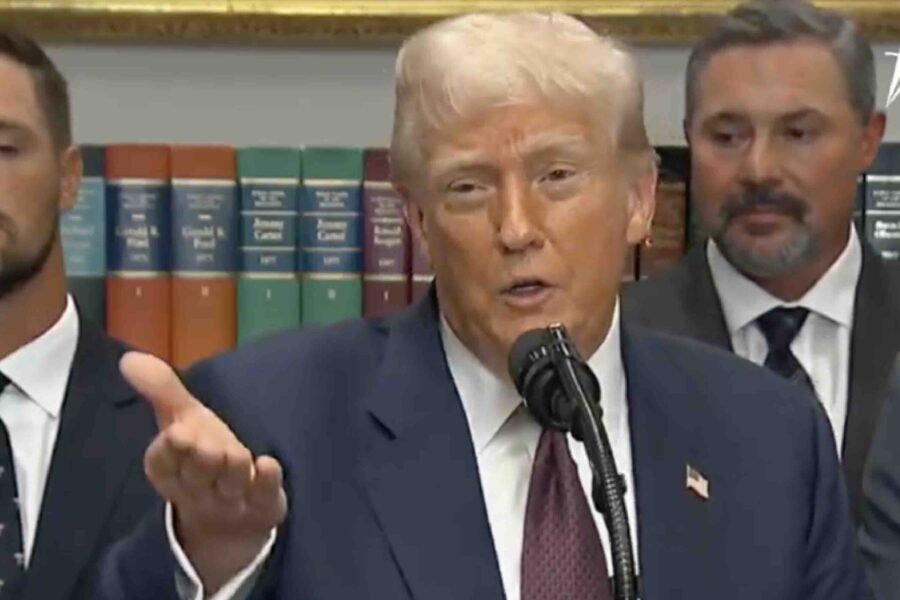
President Donald Trump took a victory lap on Friday, celebrating recent trade deals with Mexico and the European Union while levying new rates on dozens of countries around the world in a bid to pressure them back to the bargaining table.
But the cause célèbre was almost derailed by a member of the White House press corps who was put in his place after challenging the president to explain why he allegedly didn’t pursue tariffs with the same speed in his first term.
“Why didn’t you invoke this law in your first term?” the scribed asked Trump at a press conference announcing “universal” tariffs on a wide range of imports to the U.S., most of which will face a minimum 10% rate while countries with a trade deficit will be hit with an additional 5%.
Unperturbed, Trump reminded the reporter about the wall-to-wall hysteria with which mainstream outlets covered his first term, including Russiagate, impeachment hearings, and the COVID-19 pandemic.
“In my first term I was fighting lunatics like you who were trying to do things incorrectly and inappropriately to a president that was duly elected,” Trump chided his critic while pointing to “hundreds of billions of dollars” taken in from tariffs on China between 2017 and 2021.
“But when COVID came, the last thing I was gonna do was tell France and Italy and Spain and a couple of other countries that we were gonna hit you with tariffs. We had the COVID situation when that came,” he explained.
“If you look at my first term, we took in hundreds of billions of dollars in tariffs, but you people didn’t cover it very well.”
Council of Economic Advisors Chairman Stephen Miran told CNBC he expects even more revenue from tariffs than previously predicted as Trump seeks to realign the global order back in America’s favor.
“A month ago, we expected $3 trillion in revenues [from tariff collections] over a decade,” he said. “My team is still crunching the numbers as we have more tariff rates … I wouldn’t be surprised if it ended up being much closer to $4 trillion than $3 trillion.”
Miran added that recent deals with the E.U., Japan, and several other nations “laid out a road map for how other countries can get trade deals if they want.”
Earlier this week, Trump announced a 90-day deal with Mexico that will see the southern neighbor pay 25% tariffs for fentanyl, manfacturing metals, and other critical goods coming from the U.S.’s largest importer.
“It’s only a matter of time until Canada and some others” reach similar deals,” Miran explained.
“It’s in their best interest to come to deal that makes America still remain open for business,” Miran said. “Because outcomes with the deal will be much better than outcomes without a deal.”
