
Politics
NEW: Trump Launches Plan To Block Future Presidents From Re-Opening US Borders
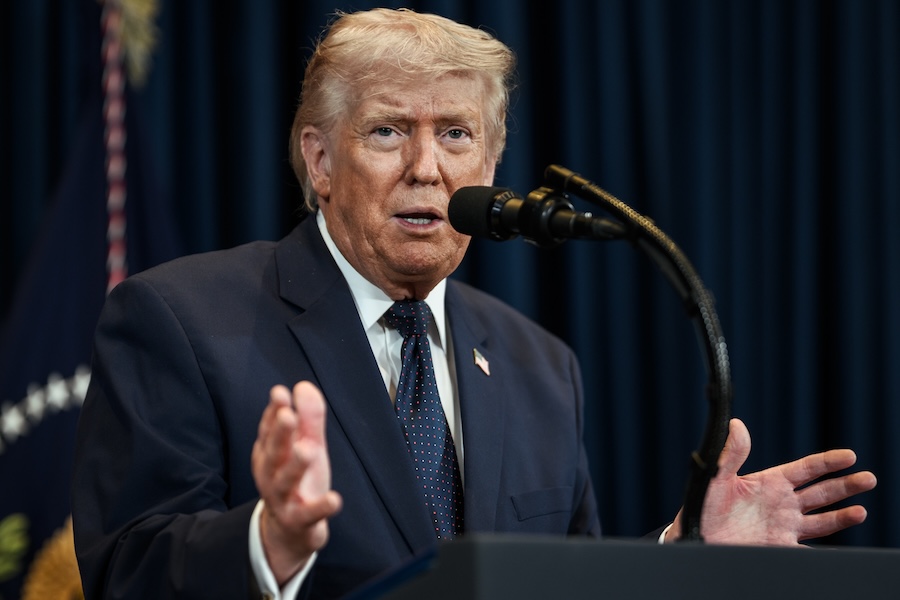
President Donald Trump unveiled a new immigration proposal Wednesday night aimed at preventing future presidents from reversing his administration’s border policies.
Speaking at the Republican midterm convention in Dallas, Trump said he wants Congress to pass legislation he called the “No Invasion of Our Country Act.”
The proposal is intended to place new legal limits on a future president’s ability to loosen border enforcement through executive action.
“We will make it legally impossible for any future president to destroy our country by having the right to open the border again,” Trump said.
The announcement came as Trump used the convention to lay out a series of policy priorities for Republicans ahead of the Nov. 3 midterm elections.
It remains unclear whether the legislation will be formally introduced or taken up by Congress before Election Day.
The proposal also raises an important legal and constitutional question: one Congress generally cannot permanently bind a future Congress, meaning later lawmakers could potentially amend or repeal any statute that is enacted.
Trump’s push is rooted in the sharp policy reversals that followed his first term.
Former President Joe Biden issued executive orders reversing several Trump-era immigration policies after taking office in 2021.
When Trump returned to the White House in January 2025, his administration again moved quickly to tighten border enforcement, expand detention and accelerate deportations.
Trump: “We will make it legally impossible for any future president to destroy our country by having the right to open our border again. We will pass a No Invasion of Our Country Act.” pic.twitter.com/Q475kHGOvk
— TheBlaze (@theblaze) September 10, 2026
The new proposal would attempt to move at least some of those restrictions from executive policy into federal law, making them harder for a future administration to undo without congressional action.
Donald Trump and congressional Republicans have repeatedly argued that relying on executive orders leaves major immigration policies vulnerable to being reversed whenever control of the White House changes parties.
Comprehensive immigration legislation has repeatedly stalled in Congress for decades, leaving presidents from both parties to rely heavily on executive authority to shape enforcement priorities.
The president has also pointed to the dramatic decline in illegal border crossings since returning to office as evidence that stricter enforcement measures are working.
His administration has expanded detention, resumed construction of border barriers and tightened asylum and parole policies.
Congressional Republicans have separately approved billions of dollars for border security, immigration enforcement and additional wall construction.
Trump’s first major immigration law of his second term was the Laken Riley Act, which expanded mandatory federal detention requirements for certain migrants accused of crimes.
The law was named after Georgia nursing student Laken Riley, who was murdered by a Venezuelan national who had entered the United States illegally.
Trump’s new proposal is broader in ambition, seeking to prevent a future administration from simply reversing his border approach through executive orders.
Whether Congress ultimately passes the measure, and how courts would interpret its limits on presidential authority, remains to be seen.
POLL: Will You Support Trump And His Candidates In The Midterms?
